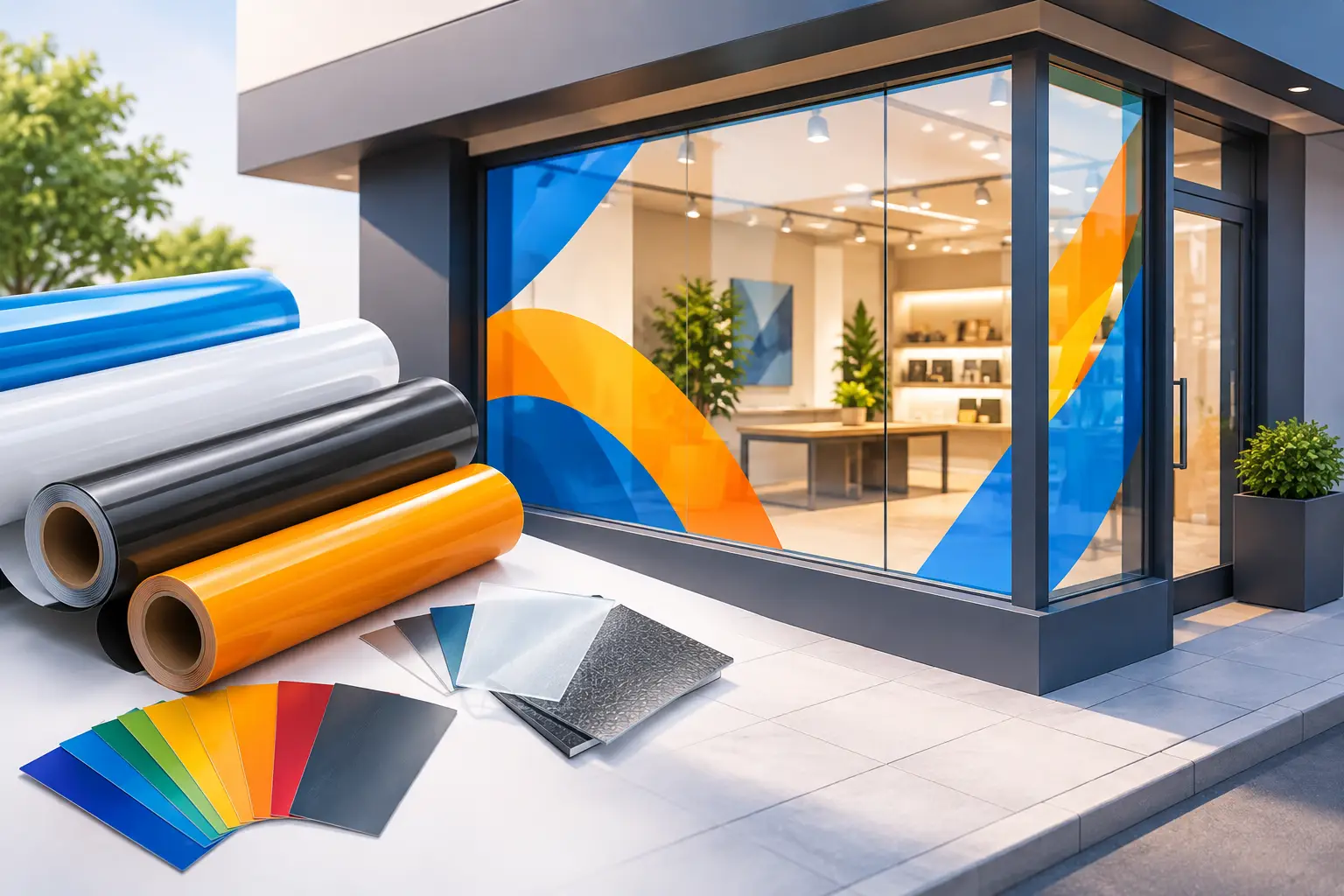
A street-facing window has two jobs: it must carry the campaign clearly from the pavement, while still working for the people inside the premises. This window graphic material review looks at the materials that affect that balance most - from full-colour promotional vinyl to privacy film and perforated graphics. The right choice depends on viewing distance, internal light, glass condition, campaign duration and whether staff need an unobstructed view out.
For a restaurant launch, retail promotion or office fit-out, the lowest material cost is rarely the most useful comparison. Reprinting a graphic that faded early, obscures too much daylight or fails at a high-traffic entrance costs more than specifying the correct film at the outset. A practical review starts with the location and application, not just the artwork.
What a window graphic needs to do
Window graphics are often asked to solve several operational problems at once. A shopfront may need strong brand coverage during a refurbishment, a promotional offer visible from across the road, and clear areas around door handles, safety markings and opening hours. An office may need meeting-room privacy without making the space feel closed in.
Before selecting a material, establish whether the graphic is intended to be read from a passing car, from a pavement a few metres away, or at close range on a glass partition. Also confirm which side of the glass will receive the film. Most external applications use material applied to the outside face, where colours are clearer and the print is not affected by reflections through the pane. Inside-mounted graphics have their place, especially where external access is restricted, but they need material and artwork designed for reverse viewing.
In Malta, exposure deserves particular attention. Strong sunlight, heat, wind-driven dust and salt air can shorten the useful life of an unsuitable film, especially on seafront sites or glass that receives direct afternoon sun. A realistic lifespan should be based on the exact facade, not only a manufacturer’s best-case rating.
Window graphic material review: the main options
Standard self-adhesive vinyl
Printed self-adhesive vinyl is the most flexible option for sales messaging, opening campaigns, seasonal promotions and branded window coverage. It delivers solid colour, sharp detail and a consistent finish across a set of sites. With the right laminate, it is a dependable choice for external graphics that need protection from handling, cleaning and UV exposure.
Gloss laminate gives colours greater visual punch and is often effective for promotional retail graphics. Matt laminate reduces glare and can make text easier to read where the glass faces strong light. The trade-off is simple: solid vinyl blocks both view and daylight wherever it is installed. It is therefore best used in planned panels, lower sections of glazing, or on windows where internal visibility is not a priority.
For short campaigns, removable adhesive can reduce clean-up at the end of the promotion. It is not a guarantee that there will be no adhesive residue, particularly on older glass, poorly maintained frames or graphics left beyond their intended period. Permanent adhesive gives stronger holding performance for long-term branding, but removal should be planned as part of the project scope.
Perforated window film
Perforated film, commonly called one-way vision, uses a pattern of small holes to show a printed image from the outside while allowing people inside to see through the graphic. It is widely used on retail fronts, hospitality venues and vehicle glazing because it can provide substantial graphic coverage without fully closing off the view.
Its benefits come with limits. The one-way effect relies on the outside being brighter than the inside. At night, when a brightly lit interior sits behind the film, the graphic becomes more transparent to people outside. Small type, fine logos and detailed product imagery can also lose definition because part of the printed surface is perforated. For that reason, perforated film works best with bold layouts, generous type sizes and high-contrast visual elements.
Where it is applied externally, perforated film needs a suitable overlaminate to protect the open holes from moisture and dirt. This is not a material to specify solely from a photograph or sample swatch. The glazing type, lighting plan and campaign viewing hours all matter.
Frosted and etched-effect film
Frosted film is designed for privacy, zoning and a refined branded finish rather than full-colour campaign messaging. It diffuses the view through glass while still allowing daylight into offices, clinics, meeting rooms, kitchens and internal partitions. Cut logos, bands and patterns can create clear wayfinding without the visual weight of a solid printed panel.
This material is particularly useful when the requirement is to stop direct sightlines rather than block light. A finance office may apply frosted bands at seated eye level to protect confidential conversations. A restaurant can use it to separate a service area from customer seating while retaining an open feel.
The decision is usually between a standard frost, which gives a neutral translucent appearance, and printed frosted film, which can carry colour, gradients or subtle branded elements. Printed frost allows more creative control, but artwork should respect the semi-transparent base. Colours will appear softer than they do on white vinyl, and an accurate proof or physical sample is worthwhile for brand-critical work.
Clear film and reverse-printed graphics
Clear film keeps the glass visible and is useful for logos, opening hours, compliance messaging and smaller decorative details. It can look clean and premium, but it is less forgiving than white-based materials. Colours printed directly on clear film can appear translucent, especially against a bright interior.
Adding a white ink layer behind the colour can improve opacity and protect brand colour accuracy. For graphics installed inside the glass and viewed from outdoors, the image is printed in reverse, often with white backing. This is a specialist production detail that must be confirmed before print, as standard front-facing artwork will read backwards when installed internally.
Clear graphics are not the first choice for high-impact promotions viewed from a distance. They are best where the architecture of the glass should remain visible and the messaging is concise.
Static-cling and short-term promotional films
Static-cling materials attach without adhesive and are suited to temporary indoor notices, limited-duration offers and graphics that may need repositioning. They are easy to apply to clean, smooth glass, but they are not designed for demanding external conditions or long installations. Heat, dust, frequent cleaning and uneven glass can compromise their hold.
For a weekend event or an internal campaign, they can be efficient. For a shopfront promotion expected to remain in place through a hot summer, adhesive-backed material is normally the safer commercial choice.
Choose by application, not by material name
A material specification should follow the job’s actual demands. Promotional windows benefit from printed vinyl when colour density and readability are the priority. Perforated film suits broad glazing where outward visibility is useful during the day. Frosted film is the stronger choice for permanent privacy and internal branding. Clear film works for concise detail and a minimal architectural finish.
Do not overlook the glass itself. Existing adhesive, silicone contamination, damaged seals, textured panes and aftermarket window coatings can affect adhesion. Double-glazed units also require care when covering large areas in dark colours, as heat build-up may a concern depending on the glass construction and exposure. A site check is sensible for extensive coverage, unusual glazing or elevated installation positions.
Door graphics require further discipline. Handles, push plates, manifestation dots, emergency exits and legally required notices must remain functional and visible. For public-facing premises, visual contrast on glass can also support safer navigation. Good artwork makes space for these requirements rather than treating them as last-minute compromises.
Print finish, installation and removal affect the result
The film is only one part of the finished window graphic. A high-resolution print may still underperform if a glare-heavy laminate, incorrect adhesive or rushed installation is used. The artwork needs suitable bleed, sensible safe margins and enough contrast for its intended viewing distance. A message intended to be read from across a road should not rely on small menu-style text.
Installation conditions matter too. Glass must be properly cleaned and dry, with site access, opening hours and working-at-height requirements agreed in advance. For multi-site campaigns, consistent measurement and placement rules prevent one branch looking different from the next. Printhub Malta can coordinate artwork preparation, production and installation as one scope, which reduces handovers when launch dates are fixed.
Removal should be considered before the first panel is fitted. If graphics are campaign-led, record the installation date, material used and planned take-down date. This makes renewal decisions easier and avoids leaving time-sensitive promotions in place after they have lost relevance.
A practical approval checklist
Before production, confirm the graphic’s purpose, installation side, size and final viewing distance. Check whether daylight, privacy or a view out must be retained. Agree whether the application is short-term or permanent, and identify any areas that must remain clear for safety, access or operational notices.
For larger projects, approve a small printed sample or a test panel on site. It is the quickest way to assess colour against the actual glazing, reflections and internal lighting. It also gives facilities and operations teams confidence that the material will perform as expected once the site is live.
The best window graphic is not simply the one that looks strongest on screen. It is the one that remains readable, appropriate and securely installed for the full life of the campaign. Specify the conditions first, then select the film that can meet them.