
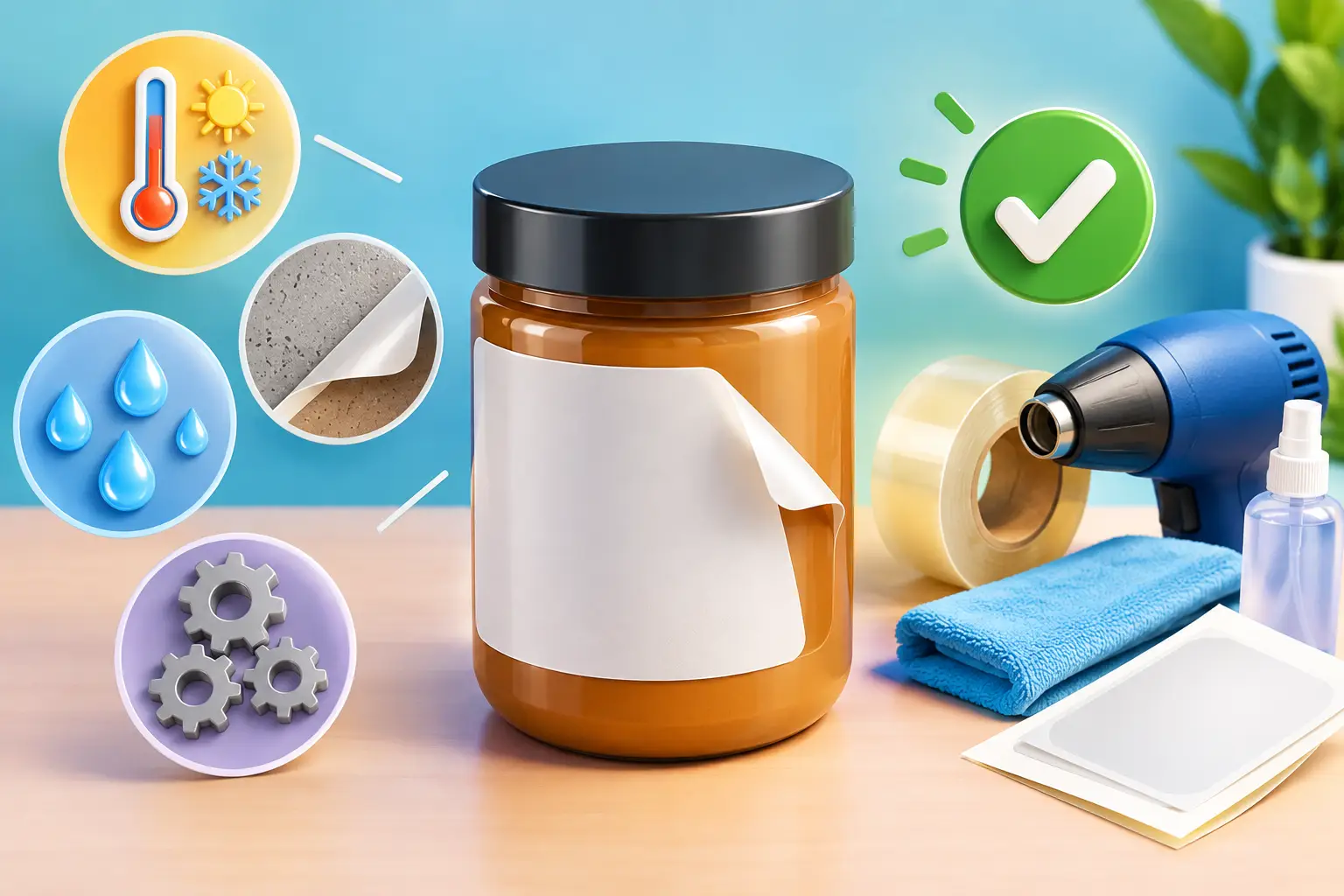
A label that lifts at the corner, slides off a chilled bottle or fails on a newly opened product line is more than a cosmetic issue. It can affect traceability, pricing, compliance information and the customer’s confidence in the product. Understanding why labels peel off means looking beyond the printed face: the surface, adhesive, application conditions and end use must work together.
For businesses managing packaging, food and beverage products, retail displays or recurring stock labels, the right question is not simply, “Which label material should we use?” It is, “What must this label adhere to, and what will it face after application?”
Why Labels Peel Off in Real Operating Conditions
Labels peel when the adhesive cannot create, or retain, sufficient contact with the surface. That may happen immediately during application, or gradually after the product has been packed, transported, chilled, handled or displayed.
The cause is often a combination of small variables rather than one obvious production error. A label may appear secure on the packing bench, then fail after a few hours in refrigeration. Another may hold on a flat sample but lift once applied around a curved jar. This is why material selection should be based on the actual operating environment, not only on how the label looks in a proof.
The surface is unsuitable or contaminated
Adhesives need a clean, stable surface. Dust, oil, moisture, flour, condensation, release agents and cleaning residues can all prevent the adhesive from making full contact. Even fingerprints can affect small labels on smooth packaging.
Low-surface-energy plastics are another common issue. Polypropylene, polyethylene and some treated or recycled plastic containers can be difficult to label with a standard permanent adhesive. The label may initially stick, but edge lift or complete release can follow during handling.
Painted, powder-coated and varnished surfaces also need consideration. A coating that has not fully cured can release gases or contain additives that interfere with adhesion. Where possible, test labels on final production components rather than on an uncoated or substitute sample.
The container is too cold or wet
Cold-chain conditions are frequently misunderstood. There is a difference between applying a label to a dry product that will later be refrigerated and applying it directly to a cold, damp product.
Most adhesives have a minimum application temperature. Below that point, the adhesive does not flow properly into the surface texture, so its initial bond is weak. Condensation makes the issue worse by creating a moisture barrier between the label and container.
For chilled drinks, refrigerated foods and freezer-bound products, specify the application temperature and the service temperature separately. A label suitable for freezer storage may still require application in a warmer, dry environment. If labels must be applied to cold surfaces, a specialist cold-temperature adhesive is usually required.
The adhesive does not match the job
“Permanent” does not mean universal. A permanent adhesive may be excellent on cardboard, glass or clean metal, yet unreliable on flexible plastic, textured packaging or items exposed to water.
The adhesive should be selected according to the substrate and the conditions it will face. A hospitality business labelling chilled bottles needs a different solution from a retailer applying promotional labels to coated boxes. A food producer using labels on oily containers may need a more aggressive adhesive than a business labelling dry paper packaging.
There is also a trade-off. A high-tack adhesive can deliver strong initial grab, but it may not be appropriate where clean removal is required. Removable labels are useful for short-term promotions, stock rotation or reusable containers, but they should not be expected to perform like a permanent product label in heat, moisture or frequent handling.
Application Errors That Cause Labels to Lift
Even a well-specified label can fail if it is applied poorly. Labelling is a production process, not just a finishing step.
Insufficient pressure during application
Pressure activates the bond by pushing the adhesive into contact with the substrate. Labels applied by hand with a light touch can trap air, particularly on textured materials. On a production line, incorrect applicator settings, worn rollers or inconsistent tamp pressure can produce the same result.
Apply labels with firm, even pressure from the centre outwards. This reduces air pockets and helps prevent corners from lifting. For high-volume work, check that the application equipment is set for the label size, container shape and line speed.
Curves, edges and awkward shapes
Flat labels resist conforming around tight curves, tapered containers, deep grooves and raised seams. The stored tension in the label material can pull it away from the surface, usually beginning at an edge.
A smaller label, a thinner face material or a different die-cut shape may solve the problem more effectively than changing the adhesive alone. For bottles and jars, label position also matters. Applying too close to a shoulder, base curve or moulding seam increases the risk of lift.
The label is applied over a join or damaged area
Labels need uninterrupted contact. Applying over a carton seam, wrinkle, dent, embossed detail or uneven shrink sleeve creates a weak point. If a pack is being filled or sealed after labelling, movement and distortion can break the bond before the adhesive has fully settled.
Allow for the full label area when designing packaging artwork and production layouts. A visually attractive placement can still be operationally unsuitable if it crosses a structural join.
Heat, Humidity and Handling After Application
Malta’s warm conditions can expose weak label specifications quickly, particularly for products stored near windows, transported in vehicles or used outdoors. Heat can soften some adhesives and cause the label material to expand. When temperatures drop again, the material contracts and edges may lift.
Humidity can affect paper labels and packaging surfaces. Paper can absorb moisture, swell and lose its flatness. If a label is regularly splashed, exposed to steam or handled with wet hands, a paper face stock may not be the right choice. Synthetic materials such as polypropylene are often more suitable for moisture-prone applications, depending on the required finish and disposal requirements.
UV exposure is a separate consideration. Sunlight can fade inks and weaken certain materials over time. For exterior applications, choose a construction designed for outdoor use and consider whether a protective laminate is needed. A laminate can improve scuff and moisture resistance, but it does not correct an unsuitable adhesive or poor surface preparation.
Storage Can Affect Label Performance Before Use
Labels can be compromised before they reach the packing bench. Rolls stored in direct sunlight, near heat sources or in very humid areas may curl, become distorted or lose their intended handling properties.
Keep label rolls in their original packaging until needed, in a clean, dry area at a stable temperature. Let materials acclimatise before use if they have been stored in a significantly cooler or warmer environment than the application area. This is particularly relevant when labels move between an air-conditioned stockroom and a warm production floor.
Adhesive performance also develops over time. Many pressure-sensitive labels achieve their full bond after 24 hours, sometimes longer depending on the adhesive, temperature and surface. Avoid judging performance solely in the first few minutes after application, but do not rely on time to compensate for a wet, dirty or unsuitable substrate.
A Practical Way to Diagnose Peeling Labels
When labels begin to fail, avoid replacing the entire label specification without identifying the pattern. Check whether the issue affects one batch, one product size, one site or one storage condition. A controlled test can prevent repeat waste across a larger run.
Start by recording the container material, surface finish, application temperature, storage temperature and how long the labels remain in place before lifting. Note whether failure begins at the corners, across the full label, or only where the label passes over a curve. These details usually point towards the likely cause.
Then test options on real products, not only on flat sample sheets. Apply labels under normal production conditions and inspect them after transport, refrigeration, handling and any cleaning process they will encounter. For a multi-site rollout, test representative samples from each packaging supplier or location, as minor variations in containers and cleaning regimes can change performance.
Where labels carry legal information, batch details, allergen statements, barcodes or pricing, build this testing into the launch plan. A failed label can create a far more expensive operational problem than a short material trial.
Specify the Label as Part of the Product Process
The most reliable label is specified with the product process in mind. Share the substrate, pack shape, application method, temperature range, exposure to water or oils, expected handling and required lifespan at the quotation stage. If the label will be machine-applied, include the applicator type and roll direction as well.
Printhub can assess these practical requirements before production, helping teams avoid a label that looks correct in artwork but fails in use. Where there is uncertainty, a physical sample trial is the sensible route before committing to a full run.
A peeling label is rarely solved by print quality alone. Treat the label, adhesive, container and operating environment as one system, and the finished product is far more likely to stay accurate, presentable and in place when customers handle it.