
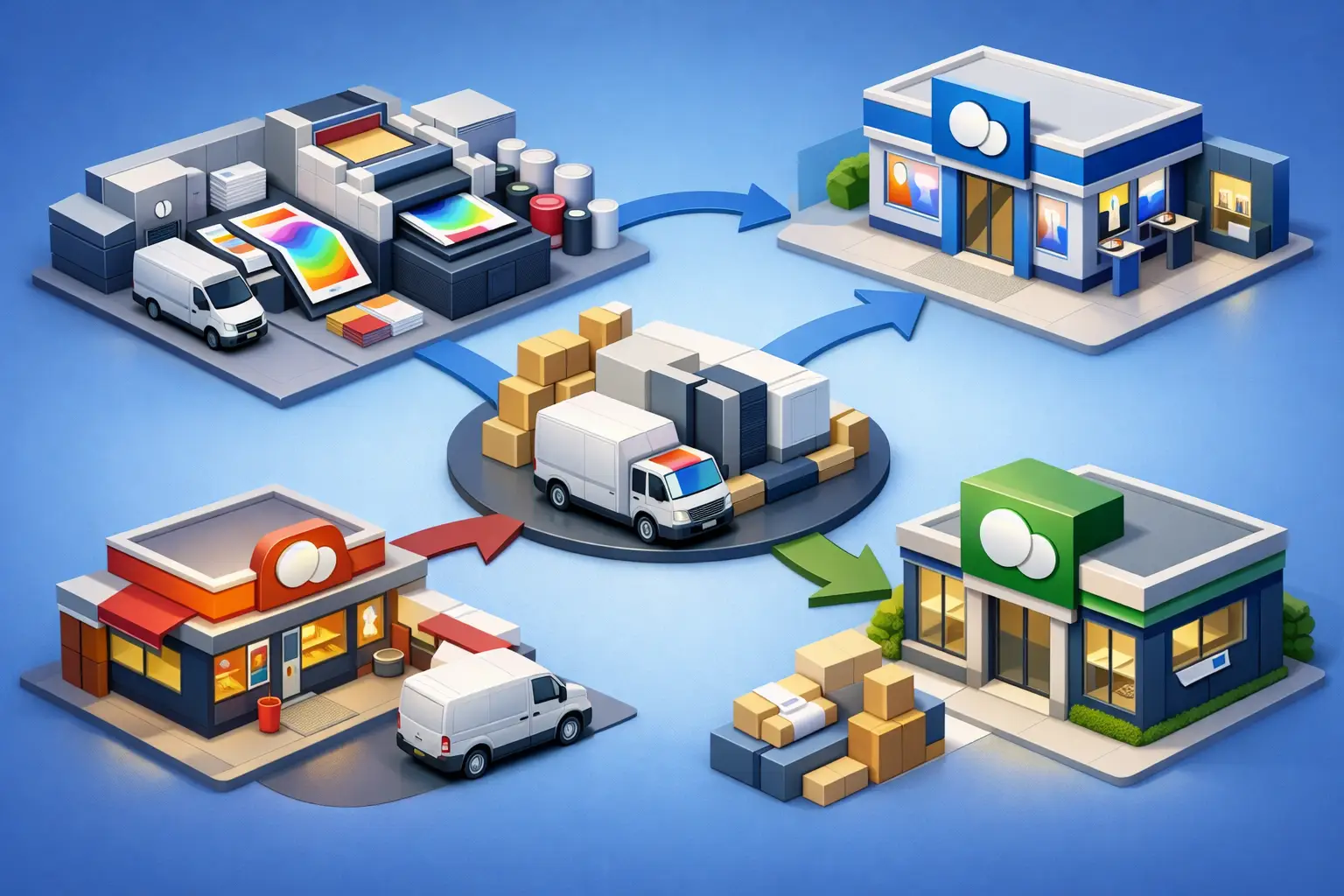
A new branch, refreshed retail estate or national campaign rarely fails because of one incorrect poster. It fails when the same brand is interpreted differently at each location, materials arrive in the wrong order, or installation is planned after the site has already opened. Multi-site brand rollout printing needs to be managed as an operational programme, not a series of separate print orders.
For marketing, operations and facilities teams, the goal is straightforward: every customer-facing site should look ready on opening day, while the people responsible for delivery know exactly what is being produced, where it is going and who is fitting it. That requires a clear production plan, controlled artwork and one accountable route from specification to installation.
Why multi site brand rollout printing needs control
A multi-site rollout can involve window graphics, exterior signs, wall vinyl, wayfinding, menus, point-of-sale displays, counter units, branded uniforms, vehicle graphics and everyday printed collateral. Each item may be simple in isolation. The difficulty comes from producing them consistently across locations with different dimensions, access rules, opening dates and site conditions.
A restaurant group may need new menus and internal graphics for established venues while a new outlet requires façade signage, frosted glass film and directional signs. A gaming operator may have standard wall graphics but different landlord requirements at each site. A retailer might be installing the same campaign in ten locations, yet only some stores have display windows or ceiling-hung fixtures.
Treating every site as identical can create waste. Treating every site as entirely separate creates inconsistency and slows approval. The practical answer is a controlled master specification with site-specific schedules. This gives teams a single version of the brand while allowing for genuine differences in measurements, materials and installation requirements.
Start with a rollout schedule, not a product list
Before approving artwork or requesting prices, build a schedule around the dates that cannot move. These might include a store handover, a public launch, a campaign start, an event, or the removal of existing branding. Work backwards from those dates and allow time for survey, artwork checks, production, finishing, delivery and installation.
The schedule should identify each location, the required items, final quantities, site contact, access hours and installation date. It should also state what must be in place before opening and what can follow later. Exterior signage, navigation and mandatory information normally take priority over promotional graphics that can be fitted after launch.
This approach prevents a common problem: a team orders all materials at once, then discovers that some sites are not ready to receive them. Finished items need safe storage, installers need access, and site teams need time to clear walls, counters or windows. A realistic schedule is more valuable than a rushed promise that ignores these conditions.
Separate standard items from site-specific items
Standard items can be approved once and produced efficiently. These may include business cards, flyers, menus, shelf strips, labels, branded merchandise and recurring campaign posters. Site-specific items need a separate check because they depend on actual dimensions and local conditions. Shopfront signs, window graphics, wall coverings, directional signage and display structures fall into this category.
That distinction helps procurement as well as production. Standard collateral can often be held as a controlled repeat order, while bespoke signage should only move to production once dimensions, substrate, fixing method and installation access have been confirmed.
Set one source of truth for artwork and specifications
A rollout loses control when several versions of a logo, campaign visual or menu circulate between head office, local managers, designers and suppliers. A file labelled ‘final’ is not enough if no one can identify whether it is final for print, final for digital use, or final for one particular location.
Create an approval pack for each rollout. It should include the approved artwork, colour references, fonts, finishing notes, material choices, quantities and a location-by-location matrix. For signage, include drawings or photographs that show placement, finished dimensions and any required clearances.
Artwork also needs to be fit for its intended output. A graphic designed for a social post may not have enough resolution for a three-metre wall. A small-format PDF may require bleed and crop marks, while a large-format print file needs correct scale and image quality. If a campaign uses brand-critical colours, specify whether colour matching is required and on which materials. Colour can appear different on paper, fabric, vinyl, acrylic and illuminated signage.
A capable print partner should flag issues before production rather than simply printing the supplied file. This is particularly valuable when internal teams are moving quickly or when campaign artwork has originated from an agency that is not managing physical production.
Choose materials for the site, not just the appearance
The lowest-cost material is not always the lowest-cost choice once replacement, cleaning and installation are considered. A short retail promotion may suit temporary window vinyl or lightweight boards. A permanent hospitality environment may need durable wall coverings, washable surfaces, laminated graphics or fabricated signage designed for repeated use.
Consider light, heat, moisture, cleaning routines and customer contact. Outdoor graphics need suitable weather resistance. Window films need the right adhesive and opacity. Floor graphics need an appropriate anti-slip finish. Illuminated signs require both visual approval and practical planning for electrical work, mounting points and future maintenance.
It also matters how the material will be installed. A large wall graphic may be straightforward in an empty unit but difficult in a live venue with furniture, customers and limited working hours. Where access is restricted, split panels, staged installation or out-of-hours fitting may be the better option.
Coordinate production, delivery and installation as one job
Print production is only one stage of a rollout. Finished materials need to arrive in the right sequence, protected from damage and clearly labelled for the correct site. Installation teams need site contacts, access instructions, parking details, health and safety requirements and confirmation that surfaces are ready.
For this reason, deliveries should be packed by location and item type rather than merely by production batch. A site manager should not have to sort through ten locations’ worth of graphics to find their own. Clear labelling also makes it easier to identify missing items before an installer leaves the workshop.
Installation planning should include a pre-install check. Are walls painted and cured? Are windows clean? Has the landlord approved the shopfront treatment? Is there power available for illuminated signage? Can a lift, ladder or access platform be used safely? These details may seem minor, but they are often what determine whether an installation is completed in one visit.
For complex programmes, appoint a single operational contact who can coordinate changes. This avoids the installer receiving instructions from several people on site while marketing expects a different outcome. Printhub supports this model by managing artwork preparation, production, delivery and on-site installation through one accountable team.
Build contingency into launch-critical work
A rollout schedule should have a clear critical path. If an exterior sign is delayed, can temporary branded panels or window graphics carry the launch? If a venue is not ready for full installation, can menus, counter displays and directional signs still be delivered for opening? Practical contingency protects the commercial date without compromising the final result.
Rush production can be useful when it is planned honestly. It may involve extra shifts, prioritised machine time, direct delivery or weekend installation. It also comes with costs and limits, especially where specialist fabrication, curing times or third-party approvals are involved. Clear rush-fee terms and realistic delivery commitments are preferable to vague assurances.
Keep a small quantity of replacement items for high-traffic locations, particularly posters, menus, labels and point-of-sale pieces. For permanent signs, retain approved artwork, measurements and material specifications so replacements can be produced without restarting the approval process.
Measure the rollout after the opening date
The work is not finished when the last item is installed. A short post-rollout review can reveal what should change before the next site, campaign or refresh. Check whether each item was delivered on time, whether materials performed as expected, whether any sites had access problems and whether local teams found the handover clear.
Photographs of completed locations are useful for brand assurance and future planning. They provide a record of placement, scale and finish, especially where the same format will be repeated across Malta. They can also expose inconsistency that is difficult to spot in an artwork approval file.
The best multi-site rollouts do not rely on last-minute effort. They rely on disciplined specifications, site-ready planning and a production partner prepared to take responsibility for the physical details that turn a brand plan into a finished environment.