
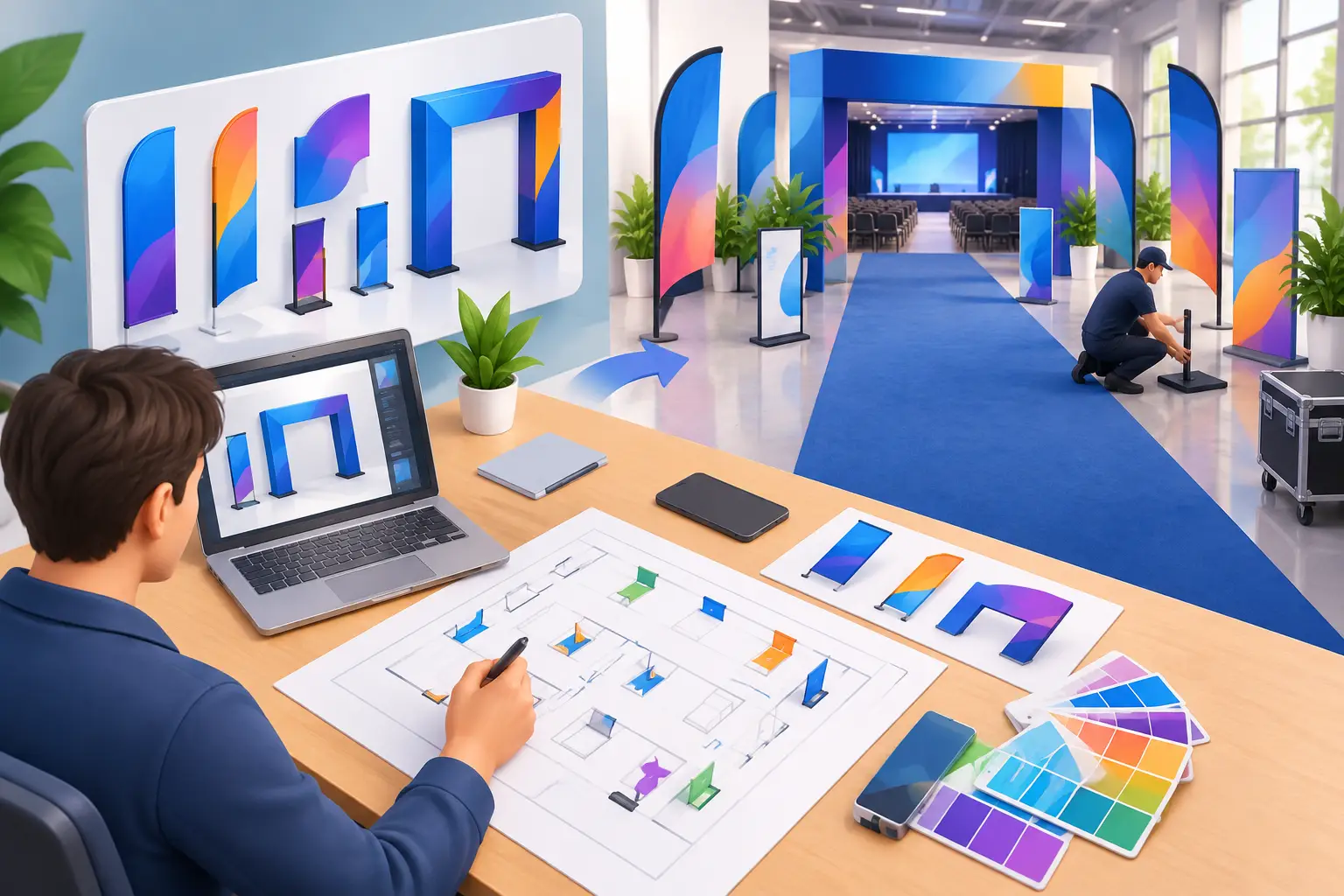
An event can have excellent speakers, catering and staging, then still feel disorganised if guests cannot find registration, the main room, the toilets or the exit. Knowing how to plan event signage means treating it as part of the event operation, not a final marketing task. The signs need to work under real site conditions, arrive in the right order and remain accurate from first guest arrival to breakdown.
For marketing and operations teams, the priority is simple: every physical touchpoint should guide a person, support the event schedule and present the brand consistently. That requires a clear sign plan, confirmed measurements, production-ready artwork and a realistic installation programme.
Start with the guest journey, not the sign types
Do not begin by ordering roller banners or directional boards because they are familiar products. Start at the point where a guest arrives and follow their route through the venue. Consider drivers entering the car park, delegates walking from nearby transport links, visitors approaching registration, VIP guests, suppliers, speakers and staff.
At each stage, identify the decision a person needs to make. They may need to confirm they are at the correct venue, find an entrance, choose a queue, locate a session room or understand where to collect a badge. A sign should answer one clear question quickly. When one board tries to display a map, sponsor logos, a programme and six directions, it usually fails at all four.
This journey-based approach also reveals where signage is operationally necessary rather than promotional. Fire exits, accessible routes, restricted areas and back-of-house access may require venue-approved signs. These should be accounted for early, particularly in hotels, conference centres, retail spaces and temporary event structures.
Build an event signage schedule
A sign schedule is the working document that keeps creative, production and site teams aligned. It does not need to be complicated, but it must record every item individually. Give each sign a reference number, then include its purpose, wording, dimensions, material, quantity, location, artwork status and installation method.
For a one-day conference, this could include external welcome signage, registration branding, queue management, room identification, stage graphics, sponsor recognition, directional signs and a photo backdrop. For a trade event or festival, the schedule will usually be broader, covering exhibitor numbers, zone markers, menus, temporary hoarding, safety notices and branded counters.
A practical schedule should also identify who owns each approval. Marketing may approve colours and logo use, while operations confirms locations, facilities approves fixings and the venue signs off access times. Leaving those responsibilities undefined is a common cause of last-minute changes.
Prioritise signs by operational risk
Not all signage carries the same consequence if it is delayed or incorrect. Entrance signs, registration instructions, room directions and event-critical safety messaging should be prioritised before decorative graphics. This matters when timings are tight or the event programme changes close to production.
Separate the schedule into three groups: essential wayfinding, event-branding assets and optional enhancements. If a late decision affects the optional group, the core guest journey can still remain protected. It is a practical way to manage risk without compromising the event experience.
Survey the venue before finalising sizes
A venue plan is useful, but it is not a replacement for a site survey. Door widths, wall finishes, ceiling height, existing signs, power points, pedestrian flow and lighting all affect what can be produced and installed.
Measure the available area rather than estimating from photographs. A 3-metre-wide backdrop may technically fit behind a stage, but it could be obscured by speakers, projection screens or furniture. Likewise, a directional sign positioned too high, too low or behind a queue barrier will not serve its purpose.
Ask the venue specific questions before committing to materials or installation methods. Can graphics be applied to painted walls? Are freestanding displays required? Is drilling permitted? Are there restrictions on floor vinyl, hanging signs or illuminated displays? What are the loading bay rules, lift dimensions and permitted installation hours?
In Malta, outdoor event signage also needs to account for wind, heat and exposure to direct sun. Lightweight displays that work indoors may not be suitable for an exposed terrace or waterfront location. The right choice might be a weighted base, rigid board, tensioned fabric system or a more substantial temporary structure. Material selection depends on the site, duration and weather risk, not just appearance.
Match materials to the job
Event signage should be specified according to where it will be used and how long it needs to perform. Foamex boards are a practical choice for many rigid indoor signs. Correx can suit short-term directional signage where a lightweight option is appropriate. Vinyl graphics work well for windows, counters and selected floor applications, subject to the surface and venue rules.
For portable branding, roller banners and fabric displays are efficient when they need to be transported, reused or moved between rooms. Large backdrops, step-and-repeat walls and stage graphics need sufficient structure and finishing to remain flat, legible and presentable in photographs.
There is a trade-off between cost, finish and resilience. Choosing the lowest-cost material may be reasonable for a short internal meeting, but less suitable for a client-facing launch, high-traffic hospitality event or multi-day exhibition. Specify the expected use honestly at the start. A production partner can then recommend materials that fit the job rather than simply producing the first option requested.
Prepare artwork for the viewing distance
Event artwork is often designed on a laptop and viewed at close range. Guests do not experience it that way. A sign above a registration desk may be read from several metres away, while a table talker is read from arm's length. The type size, contrast and amount of content must reflect that viewing distance.
Keep directional language direct: “Registration”, “Conference Room A”, “Lift”, “Toilets” and arrows pointing in the correct direction. Avoid reducing essential information to make room for logos. Brand assets matter, but a guest who misses a session because the route was unclear will not remember a perfectly placed logo.
Provide vector logos, correct brand colours and high-resolution imagery where relevant. Check that QR codes have adequate contrast and quiet space around them, then test them at the intended printed size. If the event includes multiple languages, finalise all translations before artwork is released to print. Last-minute text changes can affect layout, proofing and production timing.
Approve a proof against the sign schedule
Every proof should be checked against the sign reference number, dimensions, quantity and location, not reviewed as an isolated visual. Confirm the date, venue name, room names, sponsor marks, arrows and version of the programme. A visually attractive proof can still be wrong for the event if it uses an earlier floorplan or an outdated session title.
Once artwork is approved, avoid informal amendments through separate emails or messaging groups. Record any change against the relevant sign reference and confirm whether it affects cost or delivery timing. Clear change control prevents incorrect versions reaching site.
Plan production, delivery and installation backwards
The event opening time is not the production deadline. Work backwards from when the venue allows access, allowing time for unloading, assembly, installation, quality checks and correction of any site issues. For early-morning events, installation may need to happen the evening before.
Share practical details with the production and installation team: site contact, mobile number, loading instructions, parking arrangements, access times, floor level, lift access and whether passes or induction are required. If the site is inside a shopping centre, hotel or secure office, these details can determine whether an installation starts on time.
For larger jobs, arrange delivery in a sequence that supports installation. Heavy bases, large boards and display structures should be accessible when needed, rather than buried behind boxes of printed programmes. Keep a small contingency allowance for replacement panels, additional directional signs or a late room change where the programme is still moving.
Use a final site check before doors open
A final walk-through should follow the same route as a first-time visitor. Stand outside the venue, approach the entrance, find registration, locate each key room and check the route to facilities. Look for signs hidden by opened doors, queues, furniture, catering stations or other supplier equipment.
Check that freestanding displays are stable, graphics are clean, floor vinyl is securely applied and all illuminated or powered signs are working. Photograph the completed installation for internal records and future event planning. For recurring events or multi-site activations, these photos become a useful reference for maintaining consistency.
Printhub Malta can coordinate artwork preparation, production, delivery and on-site installation under one project plan, which reduces the handovers that often create site-day pressure. The earlier the venue details and sign schedule are confirmed, the more confidently the work can be planned around the event date.
The most useful event signage is rarely the piece that receives the most compliments. It is the sign that quietly gets every guest to the right place, at the right time, without needing to ask for help.