
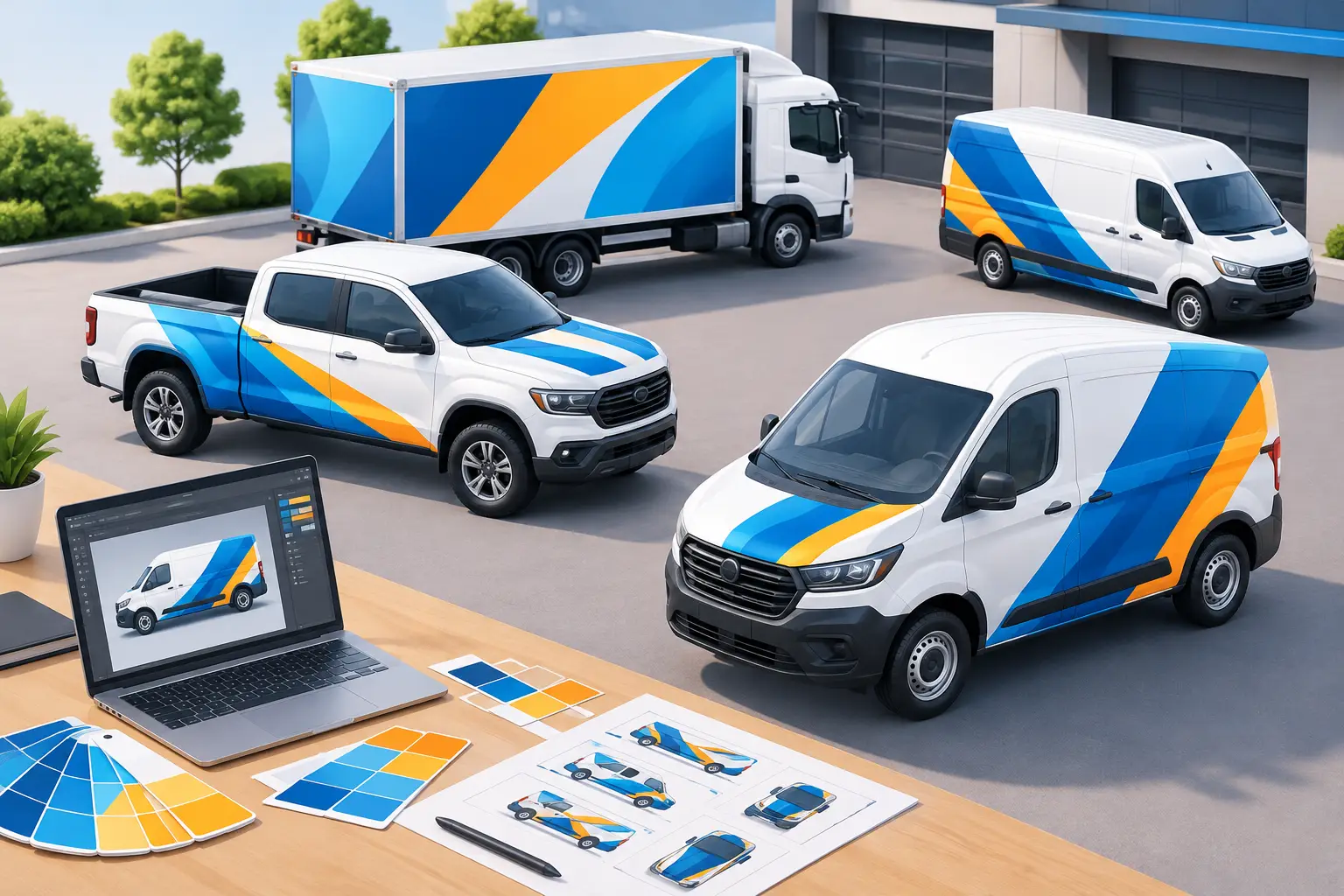
A branded vehicle has only a few seconds to be recognised in traffic, outside a client site or while parked on a busy street. That is why learning how to design fleet livery is not simply a creative exercise. It is a practical branding decision that affects visibility, credibility, vehicle downtime and the consistency of every customer-facing journey.
For businesses operating several cars, vans or lorries, fleet graphics need to work across different vehicle shapes, different viewing distances and changing working conditions. A design that looks strong on a desktop visual can become unreadable on a moving van or impractical around handles, panel joints and sensors. The right process brings marketing, operations and production requirements together before any vinyl is printed.
How to Design Fleet Livery Around the Vehicle
Start with the actual vehicle, not a generic outline. Make, model, wheelbase, roof height, door configuration and existing fixtures all change the available design area. A short-wheelbase van and a long-wheelbase van may belong to the same fleet but require different artwork layouts to retain the same visual balance.
Accurate vehicle templates are essential, but they are only the starting point. A production team should confirm the condition of the vehicles and identify practical constraints before final artwork approval. Sliding-door tracks, fuel caps, handles, parking sensors, rear cameras, ladders, chevrons and company markings can all affect placement.
The most effective fleet livery treats each side of the vehicle as its own communication space. The side panel is generally the strongest area for the company name, main service and contact details. Rear doors are valuable in traffic, where following drivers have longer to absorb a concise message. Bonnet graphics can add impact when vehicles are parked, although they should not carry critical information because they are not consistently visible.
Avoid forcing the same design onto every panel. Brand consistency does not mean repeating every element at the same size. It means ensuring the logo, colours, typeface and key message are recognisable wherever the vehicle is seen.
Set a clear information hierarchy
A vehicle is not a brochure. Trying to include every service, accreditation, phone number and social handle usually creates visual noise. Prioritise the information a customer needs to recognise the business and take the next step.
For most B2B fleets, the hierarchy should begin with the logo or business name, followed by a short description of what the company does. A website address, telephone number or concise call to action can follow if there is sufficient space and it can be read at a sensible distance.
Think about the vehicle in motion. Fine text, light-weight typefaces and complicated backgrounds may look polished in a presentation but lose clarity on the road. Use high contrast between lettering and its background, keep important copy large, and leave enough clear space around the logo for it to stand out.
This is particularly relevant for service businesses whose vehicles are seen outside hotels, restaurants, offices, retail sites and residential developments. The livery should make the company identifiable before a person has time to read every word.
Build a Design That Survives Daily Use
Fleet branding must withstand more than sunlight and rain. Vehicles are washed, loaded, parked in tight spaces and exposed to road debris. In Malta, strong UV exposure, heat and coastal air can make material selection and correct fitting especially important.
A full wrap can create a high-impact finish and allow greater creative freedom, but it is not always the best commercial choice. Partial wraps and cut vinyl graphics can deliver excellent visibility at a lower cost, with simpler replacement if a panel is damaged. The right option depends on the vehicle’s expected life, the level of brand coverage required and whether the fleet is owned, leased or regularly replaced.
Consider how the chosen colours behave in real conditions. Dark graphics can show dust and scratches more readily. Very pale lettering may disappear against bright daylight. Complex printed gradients and photographic effects can be effective for campaign vehicles, but often require greater care to reproduce consistently across future additions to the fleet.
Material choice should also match the application. Cast wrap films are suited to curved panels, recesses and full vehicle coverage, while shorter-term promotional work may call for a different specification. Laminates provide added protection and can be selected in gloss, matt or specialist finishes depending on the required appearance and durability.
The operational detail matters as much as the visual finish. A livery should not obscure legally required markings, vehicle lights, cameras or sensors. If reflective graphics, safety markings or chapter 8-style visibility treatments are required for the vehicle’s work, they must be planned into the layout rather than added as an afterthought.
Design for maintenance and replacement
Even well-maintained fleets experience minor damage. A practical livery system makes it possible to replace a door graphic or rear panel without rebuilding the entire design from scratch.
Keep approved artwork, colour references, material specifications and exact vehicle templates in one controlled file set. This is particularly useful when new vehicles are added months later, or when multiple branches need matching branding. Without that control, small changes in logo size, vinyl shade or copy can quickly make a fleet look inconsistent.
It also helps to establish rules for vehicle variations. If sales cars, delivery vans and larger lorries all carry the same identity, define which elements are fixed and which can adapt. The logo position and primary colour treatment may remain constant, while the secondary message changes according to vehicle size and function.
Plan Production and Installation Before Launch
Fleet livery projects often run alongside vehicle deliveries, site openings, campaign dates or contract start dates. Artwork approval therefore needs to happen early enough for pre-press checks, material ordering, print production and installation scheduling.
Supply logos as editable vector files wherever possible. Raster images, screenshots and low-resolution logos may need redrawing before they can be enlarged for vehicle graphics. Brand guidelines are useful, but designers also need the freedom to adjust proportions and positioning for each vehicle body without weakening the identity.
Before committing the whole fleet, approve a visual based on the exact vehicle model. For large rollouts, installing one pilot vehicle is a sensible control step. It confirms scale, colour, readability, fit around panel features and the condition of the paintwork. It is far easier to revise the design after one installation than after ten vehicles have been printed.
Installation planning should account for more than fitting time. Vehicles need to arrive clean, dry and free of wax or silicone residues. They should be available in a suitable indoor environment where temperature, dust and access can be controlled. If vehicles are working daily, staggered installation can reduce operational disruption, but this needs coordination so that the fleet does not look incomplete for longer than necessary.
For multi-site businesses, central control is particularly valuable. A single production and installation partner can retain approved files, manage repeat orders and coordinate fitting across the country. Printhub Malta supports this type of work by bringing artwork preparation, production and installation planning into one accountable process.
Measure the Livery Against Its Job
The best fleet livery is not necessarily the most decorative. It is the one that delivers the intended outcome. For a maintenance company, that may be instant recognition and a clear contact route. For a food or beverage distributor, it may be consistent presentation at every delivery point. For an events business, it may be maximum campaign visibility during a fixed period.
Review the artwork at realistic sizes and distances before approving it. View it from across a road, from behind the vehicle and in a busy car park. Ask whether the business can be identified in three seconds, whether the key message can be read without effort, and whether the design still looks considered when only part of the vehicle is visible.
A well-designed fleet livery turns everyday travel into dependable brand exposure. Give the design enough time for practical checks, use materials appropriate to the vehicle’s working life, and make every panel earn its place. The result is branding that remains clear long after the launch photographs have been taken.