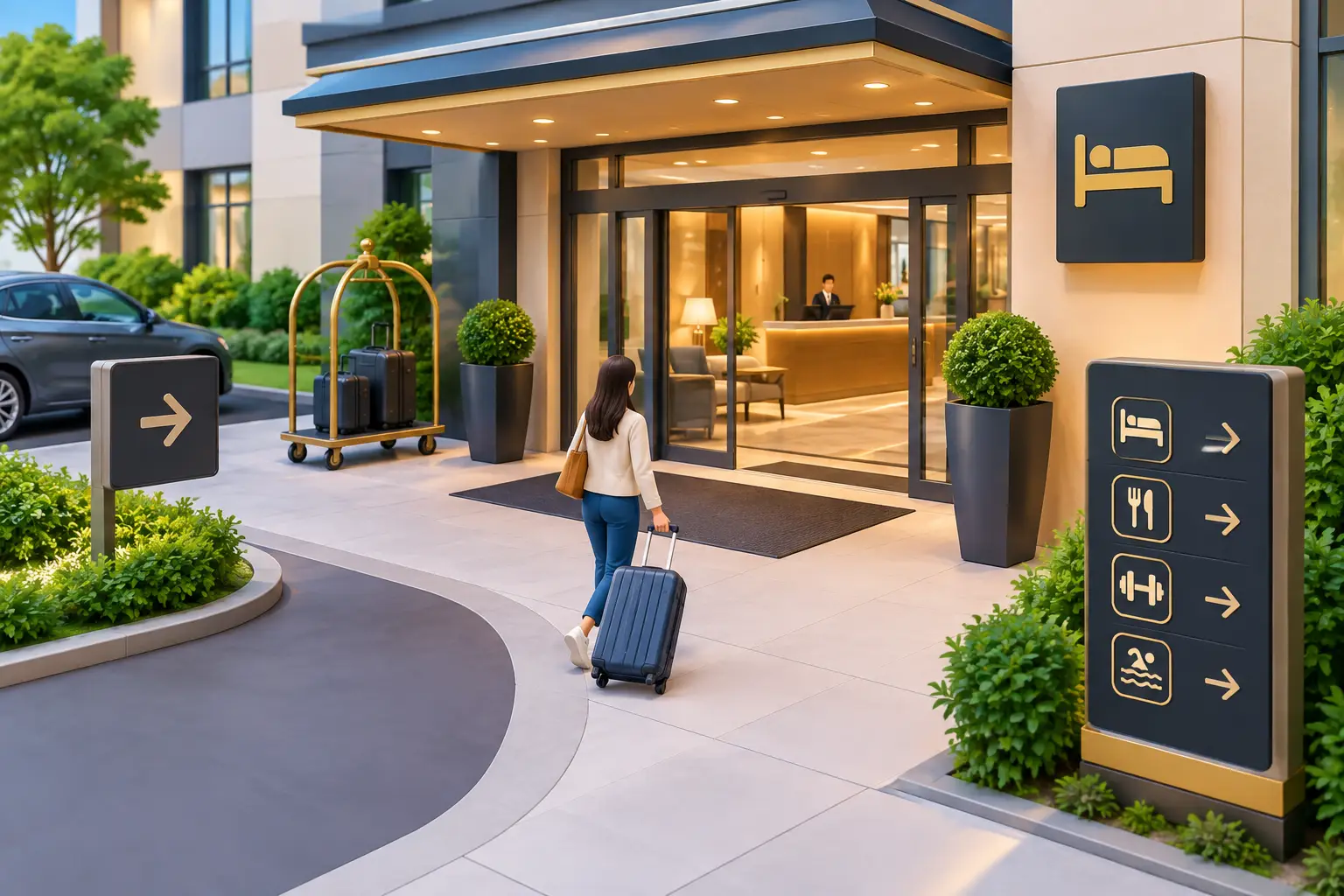
A late-arriving guest should be able to find reception, their room and the breakfast area without asking three members of staff for directions. That is the practical test behind every effective hotel signage example. Good hotel signage reduces friction for guests while helping front-of-house, housekeeping and facilities teams run a more controlled operation.
For hospitality businesses in Malta, signage also has to withstand real conditions: strong sun, salt air near the coast, frequent cleaning, high guest turnover and mixed-language audiences. The right programme is not simply a collection of attractive signs. It is a planned system of information, brand cues, safety requirements and durable materials, produced and installed around the realities of an operating property.
A hotel signage example starts with the guest journey
The most useful way to plan hotel signage is to follow the route a guest takes, from the road outside to their room and shared facilities. At every point, ask a simple operational question: what does a person need to know here, and how quickly do they need to understand it?
The first signs often sit before the entrance. An illuminated fascia, projecting sign or freestanding entrance marker confirms that guests have reached the correct property. This matters more than it may seem at night, during airport transfers, or where several venues sit within the same complex. Letter height, illumination, contrast and sightlines from the road should be considered before choosing finishes.
At the entrance, guests need confirmation and direction. Door graphics can show opening hours, accessibility information or a clear route to reception. A lobby directory should identify key facilities without becoming a dense wall of text. If the property includes a restaurant, spa, conference rooms, pool, terrace or separate accommodation blocks, the directory needs to establish names and locations consistently from the first moment.
The signage categories a hotel actually needs
A complete programme usually combines several sign types. The exact mix depends on the size of the property, building layout, guest profile and whether facilities are open to non-residents.
Exterior identity and arrival signage
Exterior branding sets expectations before check-in. Options include fabricated letters, tray signs, illuminated logos, monoliths, wall-mounted panels and directional signs for parking, drop-off points and service entrances. A premium boutique hotel may favour discreet halo-lit lettering, while a family resort with vehicle traffic may need larger, more direct wayfinding panels.
Material selection affects both appearance and maintenance. Acrylic, aluminium composite, powder-coated metal and weather-rated vinyl each serve different purposes. A sign that looks appropriate in a visual mock-up may be difficult to clean, vulnerable to fading or unsuitable for a highly exposed façade. Production specifications should reflect the site, not just the brand guideline.
Wayfinding through public areas
Wayfinding is where many hotel schemes fail. A guest may see a well-designed sign, but if it appears after the decision point, it has not done its job. Signs should be placed before lifts, corridor junctions, stairwells and changes in level - not only at the destination itself.
Typical applications include reception directories, floor indicators, lift signs, room-range signs, arrows to restaurants and meeting rooms, pool and gym directions, and parking guidance. Where there are several routes, use the same naming, colours and symbols throughout. Calling a space “Wellness Centre” on one panel and “Spa” on another creates avoidable uncertainty.
For a multilingual guest base, concise wording and clear pictograms can improve comprehension. However, symbols must be familiar and tested in context. Decorative icons can look on-brand but still leave a guest wondering whether an arrow points to toilets, a changing area or a lift.
Room numbers and accommodation identification
Room number signs are small, but they carry a great deal of daily use. They must be readable under corridor lighting, robust enough for repeated cleaning and fitted securely to a range of wall finishes. Raised acrylic, engraved laminate, printed aluminium and brushed metal plaques can all work, depending on the desired look and budget.
Accessibility should be addressed early. Tactile characters, Braille and suitable contrast may be required for certain applications and are a practical consideration for inclusive guest experience. The best approach is to agree the numbering logic before production. Changes to room allocations, wing names or floor designations after signs have been made create unnecessary replacement costs.
Safety, compliance and back-of-house signs
Hotel signage is not limited to guest-facing branding. Fire exit signs, emergency information, no-smoking notices, wet-floor warnings, capacity notices and restricted-access labels are operational necessities. They must remain visible and correctly located, even when the interior design changes.
Back-of-house signs deserve the same consistency. Deliveries, staff changing rooms, kitchen areas, waste storage, plant rooms and service corridors need clear labels. This supports contractor access, reduces interruptions to guest areas and helps new team members move around the site safely.
There is a balance to manage here. Compliance signage should be clear and durable, but it does not have to look improvised. A coordinated specification can keep mandatory signs legible while aligning secondary details, such as mounting methods and surrounding finishes, with the wider property standard.
Food, events and temporary guest communications
Hotels are active environments, not static buildings. Breakfast times change, conference rooms are reallocated, restaurants run seasonal menus and private events alter guest routes. Temporary signage needs a planned format rather than last-minute sheets taped to walls.
Reusable poster holders, menu boards, tabletop displays, window graphics, event panels and branded directional inserts make updates quicker and more presentable. For conferences, a modular system can accommodate sponsor branding, registration desks, breakout rooms and revised agendas without replacing permanent signage each time.
This is also where print quality directly affects perception. A menu that curls at the corners or a meeting-room sign with inconsistent colours can undermine an otherwise well-finished venue. Hospitality guests notice small details because those details shape their judgement of service.
Designing a hotel signage example for operations, not only aesthetics
A strong visual concept is only the starting point. Before approving artwork, the hotel team should review sign locations on-site, confirm wall substrates, check lighting conditions and identify access limitations. A panel that is easy to fit in an empty lobby may require out-of-hours installation when the hotel is occupied.
The artwork also needs production discipline. Logos, typefaces, colour references, translations, room lists and directional terminology should be signed off in one controlled schedule. This is particularly important for refurbishment programmes and multi-site groups, where a small inconsistency can multiply across dozens of signs.
Consider maintenance at the design stage. Printed wall graphics may be efficient for a seasonal campaign but less suitable where surfaces are frequently scrubbed. Magnetic or interchangeable inserts can be useful for changing information, while permanent fabricated lettering is better for fixed brand statements. There is no single material that suits every hotel zone.
Installation planning protects the guest experience
Installation is often the point where an otherwise straightforward signage job becomes disruptive. Large lobby signs, external lettering and window graphics may require site surveys, lifting equipment, electrical coordination, drilling approval or work outside guest hours. Reception and facilities teams need a clear schedule so they can manage access and communicate with staff.
For opening dates, work backwards from the first guest arrival rather than the final construction handover. Signage depends on finished walls, confirmed room numbers, live electrical points and clear routes for installers. Allowing time for a site survey, artwork checks, production, installation and final snagging reduces the risk of temporary substitutes appearing on opening day.
Printhub can coordinate artwork preparation, production, delivery and installation as one accountable process, which is particularly useful when hotel teams are already managing fit-out contractors, furniture deliveries and staff training.
Questions to settle before requesting a quotation
A reliable quotation depends on more than dimensions. Provide the property address, photographs or plans, quantities, preferred materials, existing brand guidelines, installation requirements and required completion date. If signs will be fitted at height, on glass, to stone, or in an area with restricted guest access, say so at the outset.
It is also worth identifying which information is fixed and which will change. Room numbers are generally permanent; event schedules are not. Spending more on durable fabrication for fixed signs and using flexible print formats for changing content gives better value over time.
The best hotel signage example is one guests barely notice because it answers their questions before they need to ask. When signs are clear, correctly placed and built for the site, staff can focus less on giving directions and more on delivering the service guests came for.