
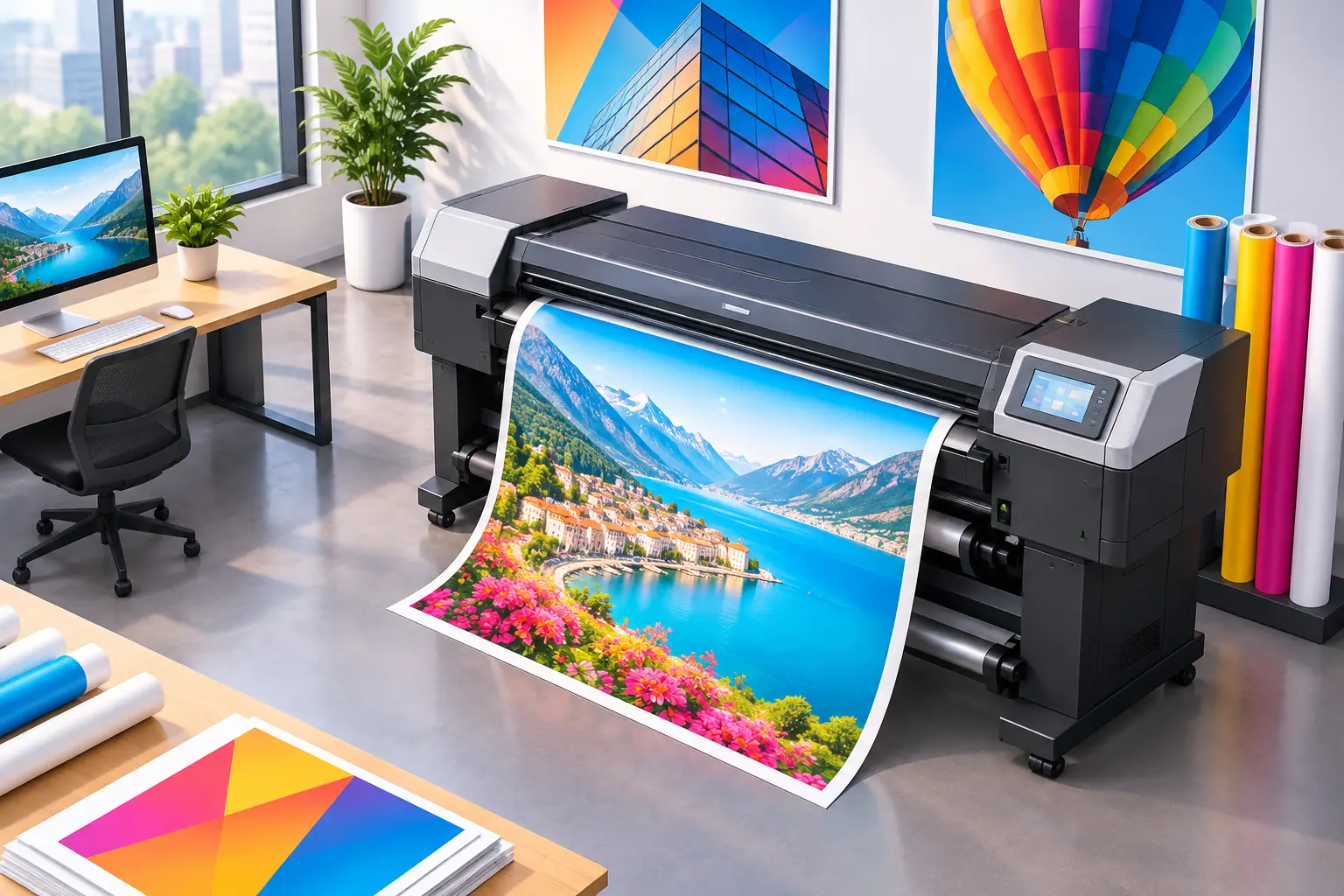
A shopfront is due to open on Monday. The campaign graphics need to match the approved brand colours, fit the measured surfaces and arrive early enough for installation. That is where a guide to large format printing becomes practical rather than theoretical. Large-format work is not simply a bigger version of a flyer or brochure. It is a production and installation process where material choice, viewing distance, site conditions and deadlines all affect the result.
For marketing, operations and facilities teams, the objective is straightforward: create visible, durable branded graphics that look right on site and are delivered when the project needs them. The right specification avoids costly reprints, delays at handover and last-minute compromises.
What counts as large format printing?
Large format printing covers graphics produced for prominent physical spaces, usually on rolls, boards or specialist sign materials rather than conventional sheet sizes. Typical applications include window graphics, wall coverings, exhibition displays, point-of-sale graphics, banners, hoardings, shopfront signs, vehicle wraps, directional signage and illuminated sign faces.
The format itself is only one part of the brief. A short-term event banner, for example, needs a different material and finishing approach from a permanent exterior sign. A graphic that will be read from across a retail floor can use a different image resolution from a reception-wall mural viewed at arm's length. Good production decisions begin with the job's real purpose, not the largest possible print size.
A guide to large format printing: start with the site
Before choosing a substrate or sending artwork, establish where the graphic will sit and what it must do. Is it indoors or outdoors? Is the surface smooth glass, painted wall, stone, cladding or a vehicle body? Will customers view it close up, from a pavement, or while driving past? Is the graphic temporary, seasonal or expected to perform for several years?
Site details determine more than aesthetics. Exterior exposure brings sun, wind, rain and cleaning requirements into the specification. High-traffic interior areas may need a laminate that resists scuffs and routine cleaning. Windows may require one-way vision film, frosted vinyl for privacy, or opaque vinyl where maximum colour impact matters. A venue with strict fire-safety requirements may need certified materials.
For multi-site campaigns, measure and photograph each location rather than assuming one site matches another. Small differences in glass panels, wall obstructions, access routes or electrical positions can disrupt a standard rollout. Site surveys are particularly valuable for wayfinding, illuminated signage, fitted wall graphics and vehicle branding, where millimetres can matter.
Match the material to the application
Large-format materials are selected for performance first, then appearance and budget. The lowest-cost option is not always the economical choice if it fails early, wrinkles during fitting or cannot be removed cleanly after a campaign.
Vinyl graphics for windows, walls and vehicles
Self-adhesive vinyl is widely used because it can be cut to shape, printed in full colour and applied to many smooth surfaces. The adhesive grade matters. Removable vinyl suits short campaigns and promotional windows, while permanent or high-tack adhesives are better for demanding surfaces. Repositionable films can make complex installations more manageable, but they are not a cure for poorly prepared surfaces.
Vehicle wrapping requires cast vinyl and compatible laminate for a professional, durable result on curves, recesses and contours. Cheaper calendared films can work for flat, short-term vehicle graphics, but are less suitable for full wraps or long-term exposure. The vehicle must also be clean, dry and available for the required fitting time.
Rigid boards for displays and signage
Foamex, aluminium composite, acrylic and corrugated plastic boards each have a place. Foamex is commonly used for interior displays and temporary signage. Aluminium composite is a reliable choice for durable exterior boards, shopfront panels and directional signs. Acrylic gives a more polished finish for reception signs, menu holders and branded displays, while corrugated plastic is lightweight and cost-effective for short-term site signage.
Thickness affects rigidity, appearance and mounting options. A large board fixed only at the corners may bow if it is too thin, especially outdoors. It is worth specifying how the board will be mounted at the outset, whether with screws, stand-offs, adhesive, frames or a fabricated structure.
Banners, textiles and exhibition graphics
PVC banners remain useful for outdoor promotions, construction hoardings and event messaging. Mesh banner allows wind to pass through and is usually the better option for exposed fencing. Fabric graphics offer a softer, premium appearance indoors and travel well for events, retail backdrops and exhibition systems.
The trade-off is practical. Fabric can reduce glare and look more refined, but may require a dedicated frame and careful handling. PVC is resilient and economical, but can reflect light and may not suit every premium customer environment.
Prepare artwork for the final viewing distance
A large print file does not automatically need an enormous image resolution. Resolution should be judged at final size and intended viewing distance. A wall graphic viewed from one metre away needs sharper source imagery than a billboard read from a road.
As a working rule, supply photographs at the highest available quality and build artwork at scale wherever practical. Vector logos, text and icons should remain vector-based, so they stay crisp at any size. Do not enlarge a small web image and expect it to perform across a three-metre display panel. The pixelation will be visible, particularly in faces, product images and fine detail.
Use CMYK artwork for print production and provide fonts as outlines or package them with the original files. Include bleed where required, particularly for graphics that will be trimmed, wrapped around a panel or fitted into a frame. Safe areas are equally important: keep essential text and logos away from trim lines, hinges, door edges, window seals and fixing points.
Colour requires sensible expectations. Screen colours are produced with light, while printed colours use inks on physical materials. They will not behave identically. Brand-critical work benefits from approved colour references, test prints or clearly defined spot-colour targets. This is especially relevant when a new sign, counter display and window campaign need to sit alongside existing branded assets.
Specify finishing and installation early
Finishing turns a printed graphic into a site-ready product. Lamination can provide additional protection, reduce fading and create a gloss, matt or textured appearance. Matt laminate is often preferable for reading under bright lights because it reduces glare. Gloss can make colours appear more vivid, although reflections may be a problem in windows and hospitality settings.
Banner finishing may include hems, eyelets, pole pockets or keder edging. Boards can be cut to shape, drilled, folded, mounted or fitted with stand-offs. Vinyl can be contour-cut, kiss-cut on sheets or applied as full panels. These details affect cost, lead time and installation method, so they should not be left until the artwork is approved.
Installation planning is just as important. Confirm access hours, parking, loading routes, lift dimensions and whether the area must remain open to customers. For elevated work, allow for appropriate equipment and site permissions. For retail refreshes and hospitality venues, fitting outside trading hours may be necessary. A graphic can be perfectly printed yet still miss its launch date if site access has not been arranged.
Build a realistic production schedule
Large format printing often involves design checks, proofing, printing, curing, laminating, cutting, fabrication, delivery and fitting. Not every project needs every stage, but each stage should be accounted for. A simple set of window decals may turn around quickly; a multi-location rollout with fabricated signs and installation requires more coordination.
Rush production can be useful when a campaign date moves or a venue handover is brought forward. It should be agreed transparently, with confirmed artwork deadlines, material availability and any rush fees stated before production begins. The most dependable route is to involve the production partner while the campaign is still being planned, rather than treating print as the final task.
For recurring activity, retain approved artwork files, material specifications and colour references. This makes repeat orders faster and helps maintain consistency across branches, event sites and seasonal promotions. Printhub Malta can coordinate artwork preparation, production, delivery and on-site installation as one accountable process, which reduces handovers between separate suppliers.
Questions to settle before approving production
A clear brief saves time at every stage. Before approving a large-format job, confirm the final dimensions, quantity, installation location, material, finish, fitting method and required completion date. Provide photographs and measurements of the site, plus any access restrictions. If the graphics must match existing signage, include the relevant brand guidelines and approved colour references.
Also establish who signs off the artwork and who will provide access on installation day. On time-sensitive projects, delayed approval and unavailable site contacts are often bigger risks than the printing itself. A single named project owner on both sides keeps decisions moving.
The best large-format graphics do more than fill a space. They make a brand easier to find, understand and trust at the exact point where customers, visitors or staff need clarity. Specify the job around the real environment, allow time for the work behind the print, and the finished result will support the business long after installation day.