
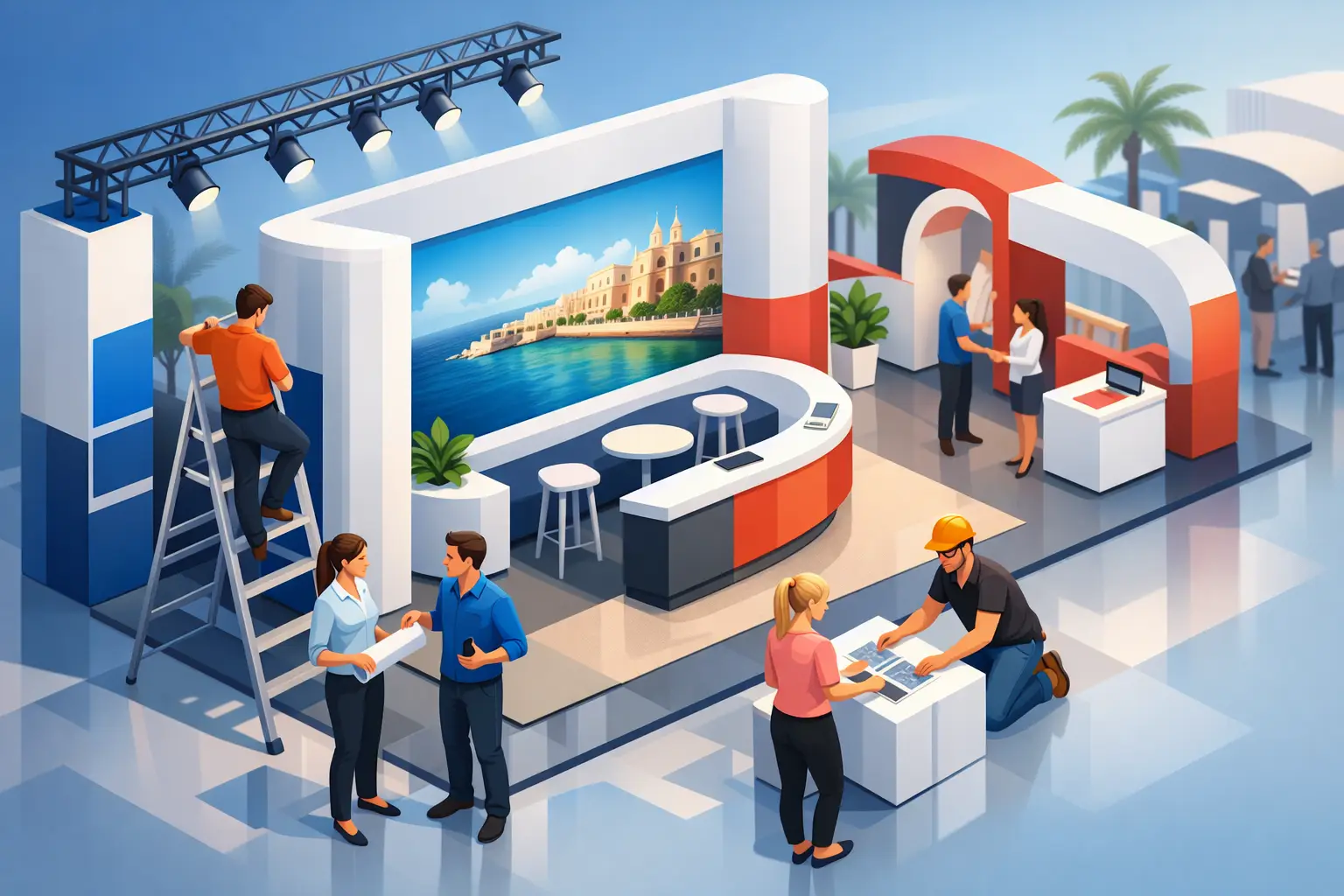
An exhibition stand has a short window to do a serious job. It must attract the right visitors, make your offer easy to understand and give your team a practical place to hold conversations. Custom exhibition stands Malta businesses commission should therefore be planned as working environments, not treated as oversized printed backdrops ordered a few days before an event.
For marketing, operations and procurement teams, the challenge is rarely just choosing a graphic. It is aligning brand requirements, available floor space, venue regulations, power access, transport, build time and budget with a fixed opening date. The best result comes from making those decisions early, with a production partner that can take responsibility for the work from artwork preparation through to on-site installation.
What a custom stand needs to achieve
A stand should make a visitor understand who you are and why they should stop within a few seconds. That does not necessarily mean filling every surface with messages. In a busy hall, a clear brand mark, one strong statement and a focused visual hierarchy will usually outperform a wall of product copy.
It also needs to support the way your team works. A hospitality operator may need a counter for samples and a screen for menus. A gaming business may need a more controlled setting for product demonstrations. A finance or professional services team may require an open, calm meeting area that feels credible without creating a barrier between staff and visitors.
The right layout depends on your objectives. Lead generation, product launches, recruitment and partner meetings place different demands on the same square metres. Confirm the purpose before finalising the structure, rather than trying to force one generic stand to serve every event.
Start with the site, not the artwork
The stand space determines more than its footprint. Corner plots, open-sided spaces and in-line shell scheme positions each need a different approach to sightlines, visitor flow and graphics. A tall backwall may be effective in one hall but restricted by the organiser in another. Likewise, a lightbox can create excellent presence, but it requires suitable power provision and time for safe installation.
Before approving design, establish the organiser's technical manual, stand dimensions, maximum build height, loading times and any rules relating to suspended elements, electrical connections or fire-rated materials. Ask where the nearest power point is, whether cables must be covered and what access is available for deliveries. These details prevent expensive alterations at the venue.
For events in Malta, local logistics still matter. Access slots can be tight, lifts may limit the size of assembled components and parking or loading areas may be shared by several suppliers. A design that looks straightforward on a visual can become difficult to install if it has not accounted for those practical conditions.
Decide what should be reusable
Custom does not have to mean single-use. Modular display systems, aluminium frames, fabric graphics, counters and freestanding elements can be designed for repeated use across conferences, roadshows and retail activations. This can reduce future production costs and speed up preparation for the next event.
There is a trade-off. A fully bespoke build can make a dramatic impact and fit an unusual space precisely, but it may require more storage, handling and assembly. A modular system is generally more adaptable, although it may offer fewer unusual shapes and finishes. The sensible choice depends on how often you exhibit, how varied your locations are and whether the stand needs to travel.
Materials and finishes should suit the job
Material selection affects both appearance and operational performance. Rigid printed panels can give a crisp, architectural look for feature walls, product messaging and mounted displays. Vinyl graphics are useful for counters, floors and existing shell-scheme surfaces. Tension fabric graphics offer a lightweight, crease-resistant option for large backdrops, while illuminated fabric lightboxes can give brand colour and imagery much greater visibility in a crowded exhibition hall.
Finishes should be selected with the viewing distance in the mind. Large-format graphics need high-resolution source imagery, but they also need enough contrast to remain legible from across an aisle. Small text, pale colours and fine detail that work in a brochure can disappear under venue lighting.
For high-touch surfaces, consider durability and cleaning requirements. Counters, tables and product plinths may need protective laminates or more resilient printed finishes. If food or drink sampling is involved, the layout should allow for practical cleaning, waste management and safe movement for staff.
A production partner should advise on these choices before print begins, particularly where brand guidelines specify colours, finishes or materials that may not be suitable for the intended application. A proof or sample can be worthwhile for brand-critical campaigns, especially where corporate colours will appear alongside existing signage, packaging or retail displays.
Build the visitor journey into the layout
The strongest stands do not make visitors work out where to go. They provide a visible invitation from the aisle, a natural stopping point and a clear next step. That may be a reception counter, a demonstration station, a product display or a booked meeting area.
Avoid placing every important message at the back of the stand. People approaching from different directions need to see the brand and core proposition before they enter. If your plot is open on two or three sides, treat each exposed side as a communication opportunity rather than relying on one front-facing panel.
Storage deserves attention too. Boxes, personal belongings, spare brochures and technical equipment can quickly undermine an otherwise polished display. Even a compact, lockable storage solution can keep the customer-facing area clear and help staff reset the space between conversations.
A practical brief for custom exhibition stands in Malta
A complete brief allows design, production and installation teams to identify risks early and quote accurately. It should cover more than the stand size. Include:
- the event name, venue, set-up date, opening time and dismantling window;
- the exact plot dimensions, open sides, height limits and organiser requirements;
- your objectives, target audience, required products, screens, furniture and storage;
- approved brand assets, copy, product imagery and any mandatory legal information;
- who will approve artwork, access arrangements and the on-site decision-maker.
The approval route matters. Last-minute copy changes can alter panel sizes, layouts and production schedules, particularly where several printed components must align. Assigning one client-side approver avoids conflicting feedback and makes it easier to protect the delivery date.
If artwork is already prepared, provide the correct files along with fonts, linked images or print-ready PDFs as requested. If it is not, allow time for design and pre-press checks. Artwork preparation is not an administrative extra: it is where incorrect dimensions, low-resolution images, missing bleed, colour issues and unsuitable file set-up are found before they become visible on a large-format panel.
Delivery and installation are part of the stand
A stand is only finished when it is installed correctly, cleanly and on time. That includes checking graphic alignment, fixing structures securely, fitting lighting where required, managing cable routes and removing protective materials before the venue opens.
Using separate suppliers for design, print, transport and fitting can appear economical at first, but it creates handover points where delays and misunderstandings occur. If a panel is damaged in transit or a final measurement changes on site, the team responsible for installation needs a direct route to the people who produced it.
Printhub Malta manages exhibition work as a connected production and installation project, giving client teams one accountable point of coordination. That is particularly valuable where the same campaign includes event graphics, printed collateral, branded merchandise, vehicle graphics or temporary wayfinding around the venue.
Urgent work can sometimes be accommodated, but urgency should be handled honestly. Rush production, late venue access or changed specifications can affect material availability, labour planning and cost. Clear rush-fee terms and realistic commitments are more useful than a promise that cannot be met once the event hall is under pressure.
Plan for the event after this one
Once the stand is dismantled, keep a record of what worked. Note the components that generated attention, the graphics visitors photographed, the awkward points in the layout and any damage or delays during installation. Store reusable structures and graphics properly, labelled by event and component, so they can be checked quickly before the next booking.
The most effective exhibition investment is not always the largest build. It is the stand that presents your brand accurately, helps staff have better conversations and arrives ready when the doors open. Start with the event date and site conditions, then give the design and production process enough time to do the job properly.