
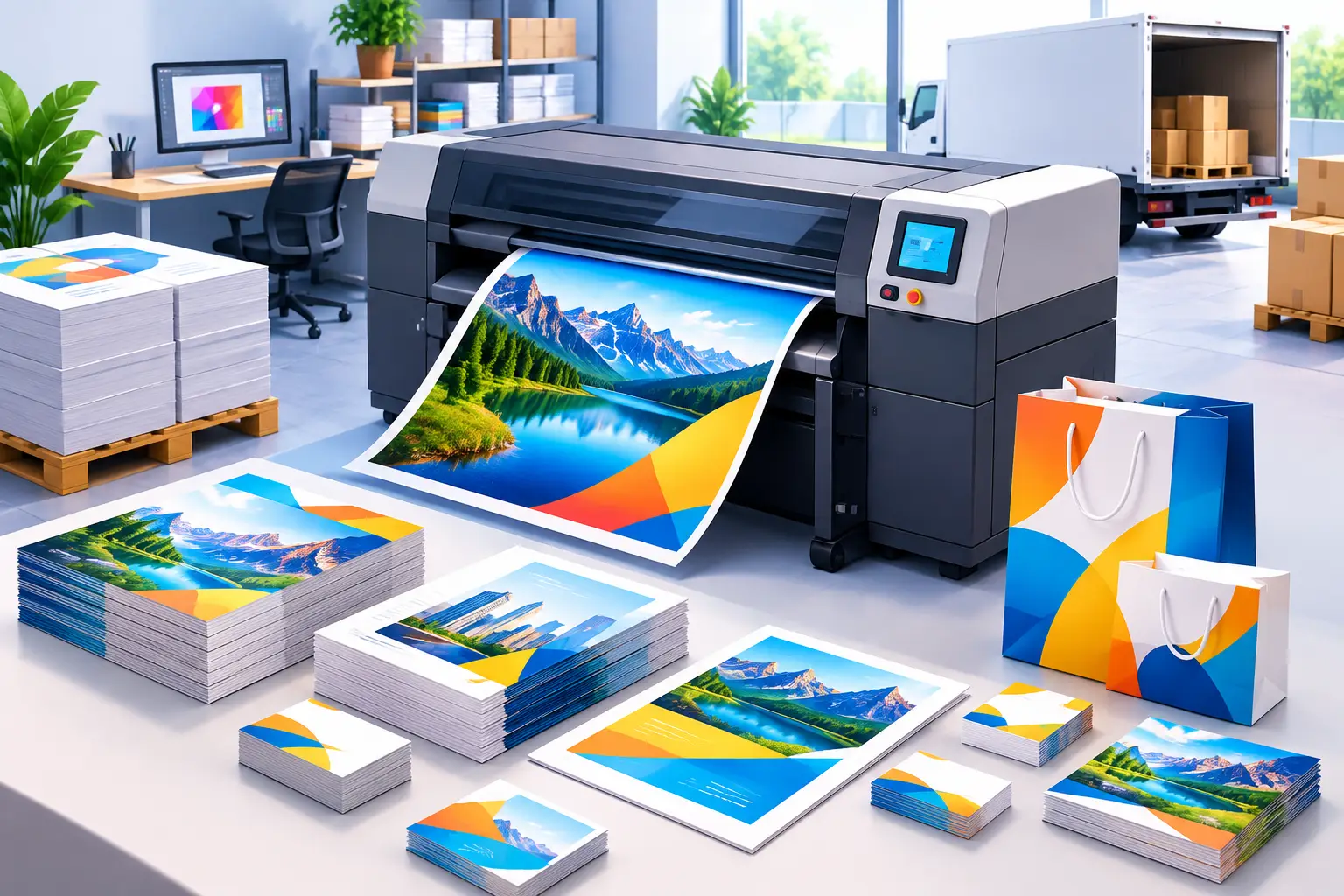
A new restaurant opening cannot trade with temporary menus, unfinished window graphics and missing directional signs. A retail promotion loses impact when point-of-sale material arrives after the launch date. This is where commercial printing becomes an operational requirement, not simply a marketing purchase. It puts the right physical materials in the right place, in the correct format, when the business needs them.
For marketing, operations and facilities teams, the challenge is rarely choosing between paper stocks alone. It is coordinating artwork, brand standards, quantities, production methods, delivery windows and, where required, site installation. A dependable print partner makes those moving parts easier to manage and makes the delivery date clear from the start.
What commercial printing covers in practice
Commercial printing is the production of branded materials used to support day-to-day business activity, campaigns, customer environments and physical locations. It can range from a run of corporate stationery to a full venue rollout involving menus, wall graphics, window vinyl, external signage and fitted displays.
For most B2B teams, the work falls into three connected areas. Printed collateral includes business cards, brochures, flyers, folders, presentation materials, vouchers, menus, labels and packaging. Brand visibility includes posters, point-of-sale displays, retail graphics, exhibition materials, branded merchandise and promotional assets. Site communication covers directional signage, safety notices, wayfinding, window manifestations, illuminated signs and large-format graphics.
The right combination depends on where a customer encounters the brand. A hotel may need durable room information, restaurant menus, event backdrops and clear wayfinding. A gaming operator may require campaign graphics across several locations, backed by accurate installation scheduling. A food or beverage business may need labels and packaging that remain legible and compliant in chilled, handled or high-turnover environments.
Treating these items as separate orders can create unnecessary risk. Colours can vary between suppliers, specifications can be missed, and nobody may own the final site-ready outcome. A coordinated approach gives one team responsibility for production detail as well as practical delivery.
Start with the job, not the product
The most useful brief explains what the item must do before specifying how it should look. A flyer designed for a short event promotion has different requirements from a menu handled hundreds of times a week. Exterior window graphics face sunlight, cleaning and changing weather. A reception sign has to suit the wall surface, viewing distance and available power if illumination is required.
This early discussion affects material selection, finish, size and production method. Laminated menus may cost more than an uncoated paper version, but can reduce replacement frequency in a busy hospitality setting. Rigid boards work well for some temporary retail displays, while fitted vinyl or fabricated signage may be more appropriate for a longer-term fit-out. The lowest unit price is not always the lowest operational cost.
It also helps to separate essential launch items from follow-on requirements. For a store opening, external signs, window graphics, point-of-sale and customer directions may be critical for day one. Branded merchandise or secondary campaign assets can sometimes follow. This prioritisation protects the opening date if plans change late in the process.
Ask the questions that prevent reprints
Before artwork enters production, confirm the finished size, quantity, intended environment, required delivery date and whether installation is included. Establish who approves the final proof and who has authority to sign off any changes. These details are particularly important where multiple stakeholders are involved, such as brand, procurement, landlord, operations and site management.
For multi-site work, create a location schedule rather than relying on a general instruction to deliver everywhere. Each site may have different access hours, loading restrictions, contact people or installation conditions. A graphic that fits one shopfront may not work on another because of glazing divisions, wall finishes or local signage constraints.
Artwork preparation is part of production control
A polished design file is not automatically ready to print. Images may be too low resolution for the intended size, fonts may not be embedded, bleed may be missing, and brand colours may have been built for screen use rather than physical output. These issues are routine, but they need resolving before production begins.
Production-ready artwork should normally include the correct dimensions, bleed and safe margins, with images supplied at suitable resolution. Print colours should be prepared for the chosen process, and special finishes, folds, cut lines or white ink layers need clearly marked instructions. Where a job involves large-format graphics, scale and panel joins require additional care.
Proofing is the point at which businesses should check more than spelling. Confirm the legal copy, offer dates, telephone numbers, QR codes, product information and location-specific details. Check that the layout still works at the actual viewing distance. Small type that looks clear on a desktop screen may fail on a shop window or directional sign.
A capable commercial printing partner can correct files, advise on practical alternatives and flag production risks. That support is valuable, particularly when an internal team is working to a campaign deadline or when several assets have been supplied by different agencies. It is faster to resolve an artwork issue before a press or printer is booked than to replace finished work after delivery.
Choose materials for use, handling and location
Paper weight matters, but it is only one part of the specification. A premium brochure may benefit from a heavier cover and a quality text stock, while a high-volume leaflet may need a cost-efficient format that remains easy to distribute. Labels need the right adhesive and face material for their surface and storage conditions. Packaging must suit both the product and the handling process.
Finishing can improve durability and perceived quality, but should be selected with purpose. Matt lamination reduces glare and helps protect frequently handled pieces. Gloss can increase visual impact on promotional artwork. Folding, creasing, die-cutting, binding, foiling and raised finishes each add production stages, lead time and cost. They are effective when they reinforce the brand or improve use, not when they are included by default.
For signage and graphics, substrate choice is even more dependent on the application. Temporary event panels, long-term outdoor signs, wall vinyl, floor graphics and vehicle wraps all need different materials and installation methods. Surface condition matters. So do lighting, cleaning routines, exposure to heat and whether the graphic must be removed without damaging the underlying finish.
Build realistic dates into commercial printing projects
Fast turnaround is valuable when it is planned honestly. The production clock starts only when artwork is approved, specifications are confirmed and any required site information is available. A request submitted early can still become urgent if approvals take several days or if the design changes after proofing.
A practical schedule sets out the approval deadline, production time, finishing requirements, delivery date and installation window. Complex work may also require a site survey, measurement check or access coordination before fabrication can begin. These stages should not be treated as optional administration. They protect the result and reduce expensive rework.
Rush production can be the right answer for a late campaign change, an event or an urgent replacement. However, it may involve additional charges, fewer material options or limits on quantities and finishing. Clear rush-fee terms allow the buyer to decide quickly rather than discovering a cost or capacity issue at the final stage.
It is also worth planning recurring materials before stock becomes critical. Menus, labels, stationery, promotional leaflets and consumable point-of-sale items can often be ordered against agreed specifications, making repeat runs faster and more consistent. For businesses with several branches, retaining approved artwork and production notes avoids repeated decisions each time a location needs replenishment.
One accountable process from file to fitted graphic
The value of commercial printing is most visible when a project has several dependencies. A campaign may require print, signs, delivery and installation to happen in a defined order. Sending materials to site without checking access, fixing methods or the condition of a wall can leave a team with finished graphics that cannot be fitted on time.
A single accountable production partner simplifies that process. The same team can assess artwork, recommend materials, produce the items, coordinate delivery and manage installation where needed. This reduces handovers and gives the client a clear point of contact when a deadline, quantity or site condition changes.
Printhub Malta works this way because business-critical physical branding needs more than a print run. It needs realistic planning, controlled production and a team that understands what must be ready when the doors open.
When preparing your next brief, start with the date, the site and the practical purpose of every item. The specification will follow more easily, and the finished work will be far more likely to perform as intended.