
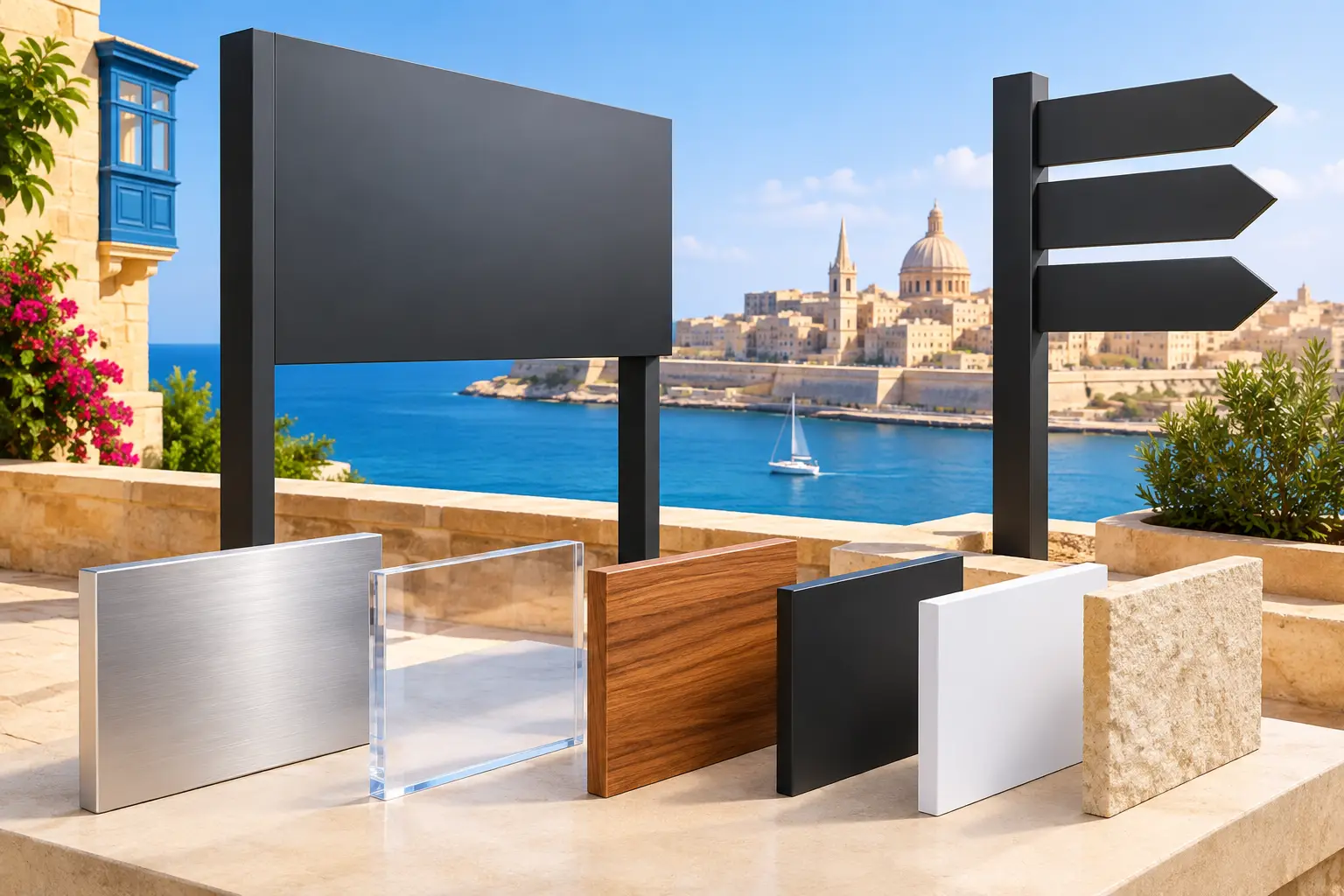
A sign that looks sharp on opening day but fades, rattles or lifts at the corners six months later is not a cost saving. For Maltese businesses, choosing the best materials for outdoor signs means planning for strong UV exposure, coastal salt, wind loads, cleaning routines and the visual standard expected at customer-facing sites.
The right choice depends on where the sign will sit, how long it needs to perform, whether it is illuminated, and how it will be fixed. A temporary event board beside a road and a permanent shopfront fascia may both carry the same logo, but they should not be specified in the same way. Material, print method, protective finish and installation all need to work together.
What determines the best materials for outdoor signs?
Start with the operating conditions, not the artwork. A sign positioned in full afternoon sun needs greater fade resistance than one under a canopy. A panel fixed high on an exposed façade requires more rigidity and stronger fixings than a window graphic. Near the coast, salt and moisture can accelerate corrosion if unsuitable metals, cut edges or fittings are used.
Expected lifespan also matters. For a short promotion, a lower-cost substrate may be sensible. For a restaurant frontage, hotel directional system or multi-site retail rollout, replacement costs, access equipment and disruption usually make a longer-lasting material the more economical choice.
The final factor is construction. A well-selected panel can still fail if it is undersized for the span, mounted with the wrong fixing centres or installed onto an unsuitable surface. Site surveys are particularly useful where walls are uneven, cladding conceals the structure, or signs need to avoid services and access routes.
Aluminium composite material for rigid outdoor panels
Aluminium composite material, commonly called ACM or aluminium composite panel, is one of the most dependable choices for permanent outdoor signage. It combines two aluminium skins with a rigid core, producing a flat, stable panel that is substantially more durable than foam PVC while remaining practical to fabricate and install.
It suits shop fascias, directional signs, estate boards, menu cases, branded wall panels and general-purpose external wayfinding. Printed vinyl can be applied to the face, or the panel can be cut, folded and combined with raised lettering, trays or illumination.
For many commercial applications, ACM offers the strongest balance of appearance, lifespan and cost. It resists moisture well and maintains a clean flat face over large areas. However, it is not automatically the answer for every sign. Very large unsupported panels may need a frame or folded returns to prevent movement, and cut edges and fixings should be specified correctly for the environment.
When to specify a heavier-duty panel
Choose a thicker panel, folded tray or framed construction when the sign is large, high-level, exposed to wind or intended to carry lighting components. This is also the better route for sites where the fascia must look crisp from close range, such as premium retail, hospitality and corporate entrances. The visible face is only part of the job: the rear structure must safely manage weight, wind and thermal movement.
Aluminium for long-term letters and built-up signs
Solid aluminium is a strong option for fabricated letters, folded trays and architectural sign elements. It is lightweight for a metal, corrosion-resistant and suitable for powder coating or painted finishes. It is commonly used where a business needs dimensional branding rather than a printed panel.
For externally illuminated lettering, aluminium construction provides a durable shell and a professional finish. It works well with LED modules, acrylic faces and concealed fixing systems. The upfront investment is higher than a flat printed sign, but it can be justified for a main entrance, flagship location or brand where signage is a permanent part of the customer experience.
The specification still needs care. Different metals should not be combined casually in damp or coastal conditions, as incompatible fixings can create corrosion issues over time. For illuminated signs, drainage, cable routing, access for maintenance and IP-rated electrical components should be addressed before production starts.
Acrylic for polished, high-visibility branding
Acrylic gives a clean, premium look and is often used for flat-cut letters, logo elements, sign faces and display panels. Available in clear, white, coloured, frosted and opal finishes, it is particularly useful when a sign needs depth, light transmission or a high-quality gloss surface.
For outdoor use, acrylic performs best as part of a designed sign system rather than as a large unsupported board. It can be used for raised lettering on an ACM backing panel, illuminated sign faces or layered reception-to-exterior branding. Acrylic can become brittle under impact and may expand and contract with temperature changes, so hole sizes, mounting methods and panel spacing need to allow for movement.
Acrylic is not usually the first choice for an exposed roadside board or a large façade panel. Its value is in detail, finish and illumination, where it creates a more refined result than a standard printed substrate.
PVC foam board for short-term and sheltered signs
Foam PVC remains a useful signage material when its limits are understood. It is lightweight, easy to cut and cost-effective for temporary campaigns, event signage, property boards and short-to-medium-term promotional displays. It accepts direct print and vinyl graphics well.
For outdoor use, it is better suited to sheltered positions or smaller panels. In sustained heat, sun and wind, larger foam PVC boards can bow or become less presentable over time. That makes it a poor choice for permanent shopfronts, exposed directional signs or high-visibility corporate branding.
The commercial decision is straightforward: use PVC foam where the campaign is genuinely temporary or the location is protected. If the sign will remain in place for years, ACM usually avoids an earlier replacement and the associated installation cost.
Vinyl graphics for windows, walls and vehicles
Vinyl is not a rigid sign material, but it is essential to many outdoor branding programmes. It can be applied to shop windows, glazed partitions, vehicles, ACM panels and other prepared surfaces. The performance of vinyl depends on its grade, adhesive, laminate and the condition of the surface beneath it.
For long-term external graphics, a polymeric or cast vinyl with UV laminate is generally the appropriate choice. Cast vinyl is especially valuable for vehicle wraps, curves, recesses and complex surfaces because it conforms more effectively and remains stable over time. Monomeric vinyl may be suitable for short campaigns on flat surfaces, but it is not the right economy for a long-term wrap or exposed installation.
Lamination provides protection against UV, abrasion and routine cleaning. It can be gloss, matt or anti-graffiti depending on the location. A matt laminate can reduce glare on sunny façades, while gloss may suit high-impact retail graphics. The correct finish should support legibility as well as appearance.
Corrugated plastic and banners for temporary visibility
Corrugated plastic boards are lightweight and economical for estate agents, construction notices, event directions and short-duration promotions. They are easy to move and install, but their fluted structure gives them limited rigidity and a less premium appearance. They are best kept to applications where speed and low cost matter more than a long service life.
PVC banners are useful for events, openings, perimeter branding and temporary messages over a larger area. Mesh banner material can reduce wind loading in exposed locations, while standard PVC banner gives stronger colour density where wind is less of a concern. Both need correctly positioned eyelets, hems and tensioning. A banner that is loosely fixed will wear faster and look poorly managed, regardless of print quality.
Match the finish and installation to the material
Material selection should always include the graphic finish. Outdoor inks and printed vinyl must be suitable for UV exposure. White ink, metallic effects, reflective films and laminated finishes can all be useful, but each has different production and durability considerations.
Installation is equally decisive. Signs may require screws with finishing caps, concealed studs, adhesive systems, aluminium rails, freestanding posts or a fabricated frame. The chosen method affects not only appearance, but also whether the sign can be safely maintained or replaced. For multi-site projects, standardising panel sizes, colours, fixing details and artwork versions helps keep every location consistent.
Before approving production, confirm the final dimensions, viewing distance, wall substrate, electrical requirements, access restrictions and required completion date. If a site is due to open on a fixed date, allow time for survey, fabrication, installation and any landlord or local authority permissions that may apply.
For business-critical signage, the best result comes from treating the sign as a site asset, not simply a printed item. Printhub can advise on the practical combination of material, graphics and installation method before production begins, helping teams specify a sign that remains clear, secure and on-brand long after launch day.