
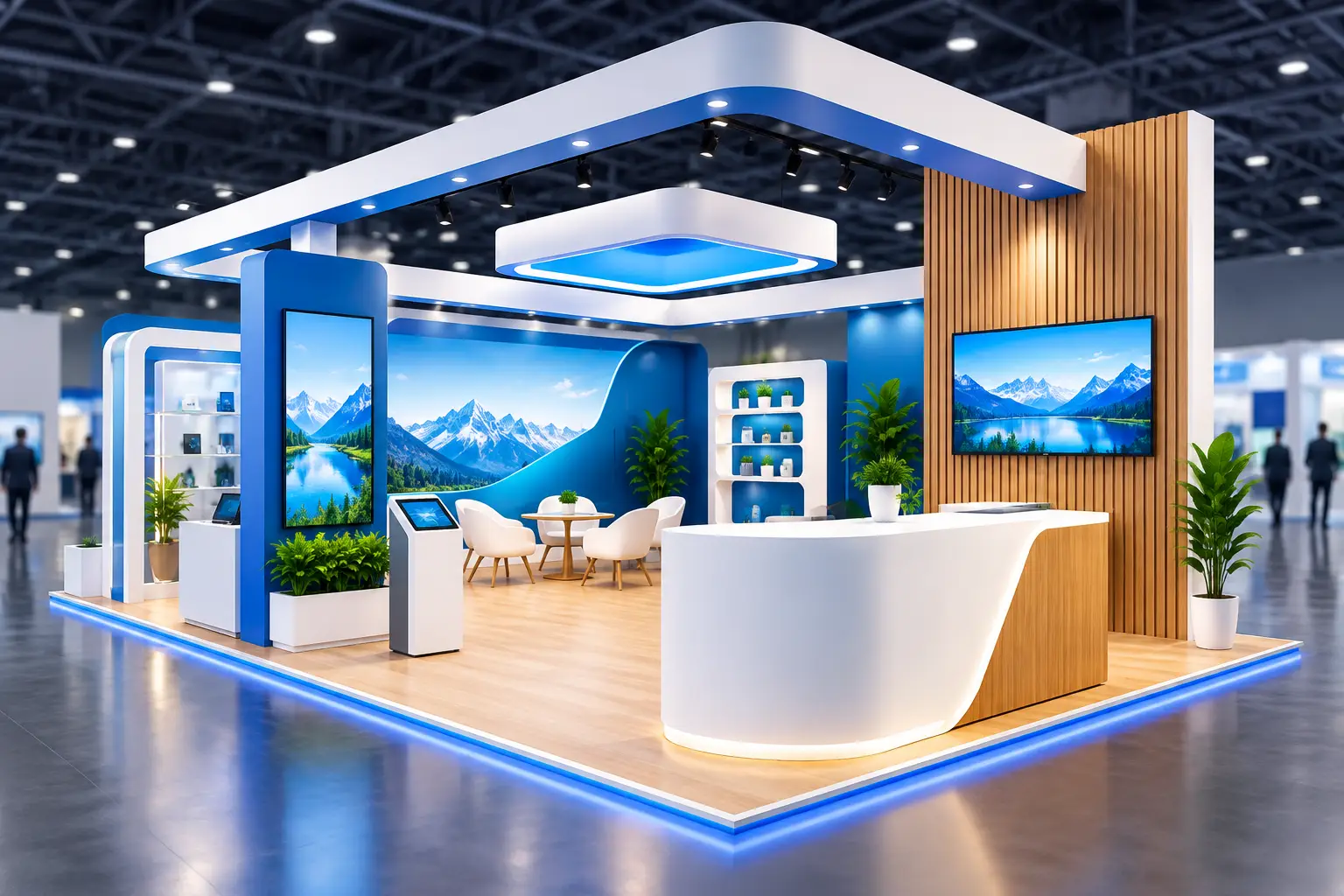
A stand can have excellent graphics and still fail at an exhibition if visitors cannot tell what you offer from the aisle, staff have nowhere to hold a useful conversation, or the structure is not ready when doors open. The best exhibition stand features are the ones that support commercial outcomes while remaining practical to produce, transport, install and reuse.
For marketing and operations teams, this means treating the stand as a working physical environment, not simply a large printed backdrop. Every element should have a job: attract the right people, communicate a clear message, support the sales conversation or make the event day easier to manage.
1. Clear branding visible from the aisle
An exhibition stand has only a few seconds to be understood. Your company name, logo and primary offer need to be visible above heads and across the main approach route, not only to people already standing in front of the stand.
Use a concise message that answers what you do or why a visitor should stop. A hospitality supplier may lead with a new menu concept; a finance business may focus on a service proposition; a gaming brand may promote a specific product release. Avoid filling the main wall with every product category, brand value and contact detail. That information belongs lower down the stand, in brochures or in the conversation.
Contrast matters as much as logo size. Brand colours must look accurate under venue lighting, while text needs sufficient separation from the background to remain legible at distance. Artwork that looks balanced on a laptop can become difficult to read when enlarged to several metres wide.
2. A layout built around visitor flow
The most attractive graphic cannot compensate for a stand that creates a queue at the entrance or blocks staff from engaging people. Plan the layout around how visitors will approach, pause and move on.
An open frontage usually works well for businesses that need a high volume of short conversations. A more enclosed setting can be appropriate for financial services, premium hospitality, technical demonstrations or meetings involving confidential information. The trade-off is clear: privacy reduces the number of casual interactions, while an entirely open stand can make detailed discussions difficult.
Keep the first metre of the stand clear where possible. Promotional counters, sample displays and screens placed immediately at the edge can form a physical barrier. Position engagement points slightly inside or to one side, giving visitors a straightforward route in and a natural place for staff to greet them.
Plan for the real footprint
Before production starts, confirm the stand dimensions, wall height limits, power locations, rigging rules, fire requirements and permitted build times. Also consider neighbouring stands. A key message placed on a side wall may be hidden by the next exhibitor's structure. These details are routine, but resolving them before print protects both budget and deadline.
3. Modular structures that suit repeat events
For companies attending several exhibitions each year, a modular system is often more commercially sensible than producing a new stand from scratch each time. Reconfigurable frames, fabric graphics, pop-up systems and portable display walls can be adapted for different footprints while keeping the same core brand presentation.
Modularity does not mean every stand needs to look identical. A central branded structure can be supplemented with event-specific graphics, product panels or campaign messaging. This gives marketing teams flexibility without replacing the full system for each exhibition.
There are limits. A lightweight modular stand is ideal for speed, storage and repeat use, but it may not deliver the architectural presence required for a flagship launch or a large exhibition space. Bespoke joinery, illuminated elements and integrated display areas make sense where the expected footfall, product value or brand occasion justifies the investment.
4. Lighting that makes products and graphics work harder
Venue lighting is rarely designed around your brand. Exhibition halls can be unevenly lit, and graphics close to the floor may fall into shadow. Good stand lighting gives the display shape, brings out product detail and ensures staff can speak with visitors in a professional setting.
Illuminated fabric walls and lightboxes are especially effective where the stand must stand out across a busy hall. They provide consistent brightness and can make colours appear more controlled than spotlights alone. For product displays, directed lighting can draw attention to packaging, bottles, samples or technical equipment.
However, lighting requires early coordination. Check available power, cable routes, electrical approvals and whether the venue requires equipment testing documentation. Do not leave these questions until installation day, particularly when the stand includes screens, charging points or illuminated signage.
5. Graphics designed for distance, not just detail
Large-format print needs a different approach from a brochure or social media asset. Fine copy, narrow typefaces and complex imagery may reproduce correctly but still fail from three metres away.
Build the graphic hierarchy in layers. The brand and headline should be readable from the aisle. A secondary statement or product category can work at mid-distance. Supporting details such as specifications, QR codes and calls to action belong where a visitor can stand close enough to use them.
Use high-resolution imagery supplied at the correct scale, and allow for panel joins, frame edges, doors and furniture. A face or critical word split across a join looks careless, even when the print itself is technically perfect. A pre-production artwork check should account for the final stand drawing rather than reviewing graphics as isolated files.
6. A useful demonstration or product display area
People remember what they can see, touch or try. Where relevant, create a focused area for samples, live demonstrations, tastings, interactive screens or product comparisons. The feature should support the sales conversation rather than compete with it.
For a food or beverage brand, this might mean a clean, accessible tasting counter with practical storage underneath. For a technology provider, it could be a screen showing a short product journey, supported by a staff member who can answer questions. For retail and packaging businesses, physical samples often carry more weight than a wall of claims.
Allow enough working space for replenishment, cleaning and secure storage. An elegant counter that has nowhere for stock, personal belongings, literature or basic equipment quickly becomes cluttered. The public-facing finish and the operational side of the stand need to be designed together.
7. Lead capture that does not interrupt the conversation
The purpose of most exhibitions is not simply footfall. It is qualified follow-up. A stand should make it easy for staff to record interest while the interaction is still fresh.
Digital forms, badge scanners, tablets and QR codes can all work, but the method should match the team and the event. A QR code is useful for visitors who prefer to browse independently, but it should not be the only route to contact. Staff also need a reliable process for noting requirements, decision timescales and the person responsible for the next step.
Place the call to action where it is visible but not intrusive. A clear invitation to book a meeting, request a sample pack or receive a quotation is more effective than a generic instruction to “get in touch”. If connectivity is uncertain, ensure there is a fallback process rather than relying entirely on a web form.
8. Practical storage and concealed working areas
Storage is one of the most overlooked exhibition stand features. Literature, giveaways, stock, bags, tools, cleaning materials, cables and staff refreshments all need somewhere to go. Without proper storage, these items appear on counters and behind graphics, undermining the overall presentation.
Even a compact lockable cupboard can transform how the stand operates. Larger spaces may need a concealed back-of-house zone for stock and staff preparation. This is particularly valuable for catering, sampling activity or product launches where supplies need regular replenishment.
Consider access during the event as well as capacity. A store room that can only be reached by moving furniture is unlikely to be used properly during busy periods.
9. Durable materials and reliable finishing
Exhibitions involve handling, transport, venue loading bays and repeated assembly. Material selection should reflect how long the stand will be used and how it will travel. Short-term foamboard panels may be suitable for a one-off indoor event, while reusable fabric systems, laminated graphics or rigid display materials are better suited to frequent use.
Finishing details influence how professional the stand feels. Clean-cut edges, aligned panels, stable bases, wrinkle-free fabric and correctly fitted graphics matter because visitors notice inconsistency quickly. The same applies to branded counters, flooring, window vinyl, flags and supporting signage.
For multi-part stands, label every component and pack it in a way that protects graphics between events. Reprint costs are avoidable when storage and transport are planned from the start.
10. Installation planning that protects the launch date
The final feature is not always visible to visitors, but it is often the difference between a calm event opening and a last-minute problem: a proper installation plan. This includes access times, loading arrangements, parking permissions, venue contacts, stand drawings, electrical requirements, delivery sequencing and a clear handover process.
In Malta, venue access and event build windows can be tight, especially when multiple suppliers are working at the same time. Agree who is responsible for delivery, assembly, finishing checks and removal before production begins. If the stand includes large-format graphics, illuminated signage or custom-built elements, allow realistic lead time for artwork approval, manufacture and site work.
A single accountable production and installation partner reduces the handovers between designer, printer, fabricator, courier and on-site crew. Printhub Malta supports this process from artwork preparation through to installation, helping teams keep brand presentation and practical delivery under the same control.
The best choice is not necessarily the largest stand or the one with the most features. It is the stand that gives your team room to work, gives visitors a reason to stop and arrives ready for the moment the exhibition opens.