
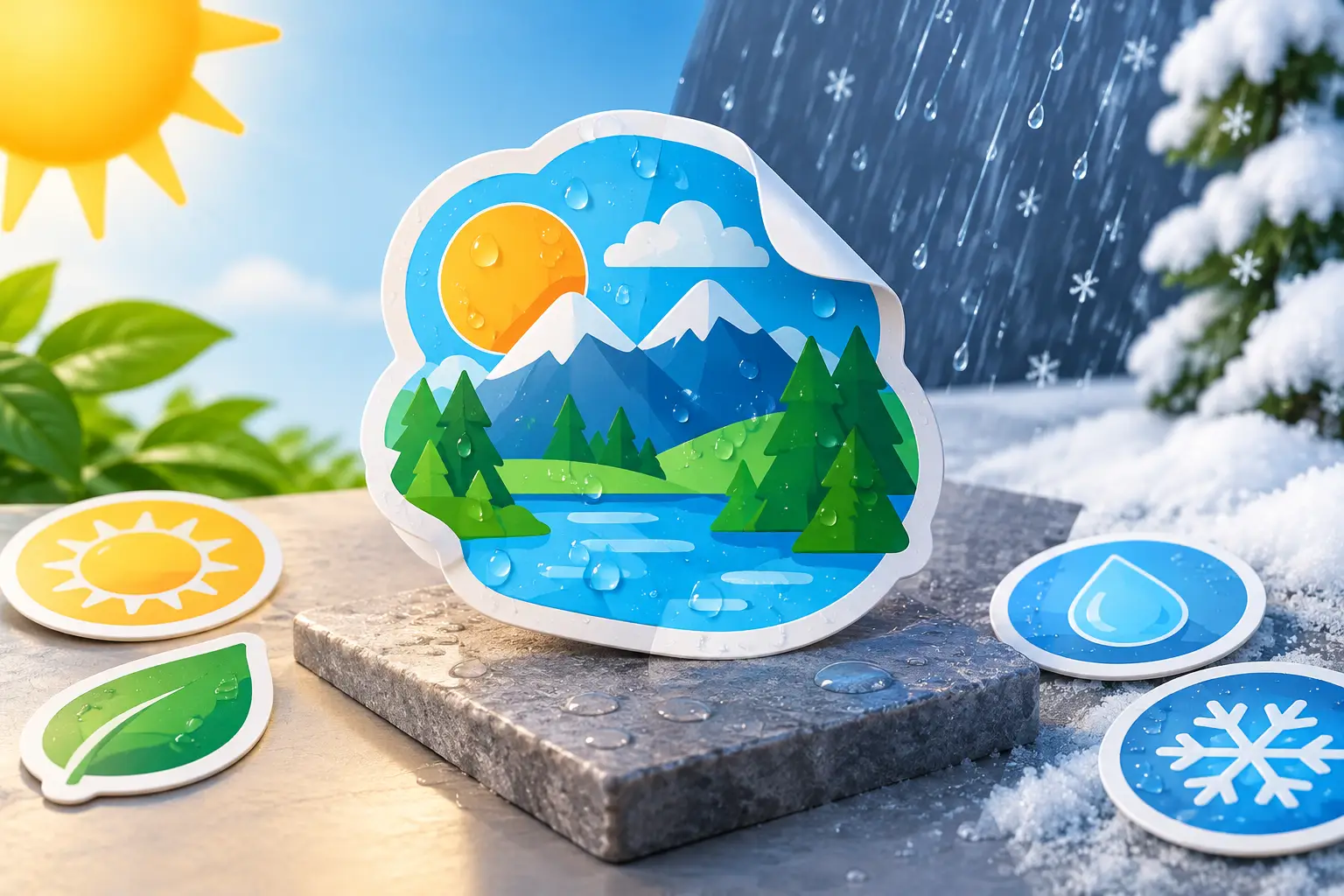
A promotional sticker on a chilled drinks fridge, a vehicle decal crossing Malta every day, and a window graphic at a seafront restaurant do not face the same conditions. Asking are stickers weatherproof is the right starting point, but the useful answer is not simply yes or no. A sticker is only weatherproof when its material, ink, laminate, adhesive and application surface are specified for the environment it will face.
For business use, that distinction matters. A sticker that curls at the corners, fades after one summer or leaves adhesive residue during a campaign changeover creates avoidable replacement work. The correct specification protects the brand presentation as well as the production budget.
Are stickers weatherproof by default?
No. Some stickers are designed for short indoor use only, while others are made to withstand prolonged outdoor exposure. Paper labels, for example, can be ideal for packaging, menus, jars and internal promotions, but they are not the automatic choice for rain, direct sun or frequent cleaning. Even a surface that looks dry can be exposed to condensation, steam, oils, refrigeration and abrasion.
Outdoor-grade stickers are typically produced on self-adhesive vinyl, with UV-resistant printed inks and a protective laminate where required. This combination improves resistance to moisture, sunlight, scuffs and routine cleaning. However, “weatherproof” should be treated as a performance requirement, not a blanket promise. A vinyl sticker applied to a clean, smooth painted panel will generally last far longer than the same sticker applied to rough render, dusty plastic or a low-energy surface.
The intended lifespan also changes the answer. A three-day event decal, a six-month campaign graphic and a five-year vehicle marking should not be quoted or produced as though they were the same item.
What makes a sticker suitable for outdoor use?
The face material
Vinyl is the usual starting point for outdoor stickers because it is flexible, water-resistant and available with different levels of durability. Monomeric vinyl is often suitable for flat, short- to medium-term applications such as temporary window promotions or simple boards. Polymeric vinyl offers better dimensional stability and is a stronger option for longer campaigns, exterior panels and demanding exposure.
For curved surfaces, corrugated panels or vehicle applications, a cast vinyl may be needed. It conforms more reliably around contours and is less likely to shrink over time. This is a practical production decision, not an upgrade for its own sake. Using a lower-grade film on a complex vehicle curve can result in lifted edges and a finish that looks poor before the campaign has run its course.
The print method and inks
The printed image must withstand ultraviolet light as well as rain. Direct sun can fade certain colours, particularly bright reds, yellows and magentas, before the material itself shows signs of wear. Outdoor-capable print processes and suitable inks help retain colour strength, but expected exposure still needs to be considered.
If brand colour accuracy is critical, provide the correct brand references and advise where the stickers will be installed. A logo on a shaded internal glass door has different production needs from the same logo on a south-facing shopfront or delivery vehicle.
Lamination
A clear laminate is often the layer that turns a capable printed vinyl into a more durable working graphic. It protects the print from scratching, cleaning chemicals, moisture and UV exposure. Gloss laminate can make colours appear more vivid, while matt laminate reduces glare and gives a more subdued finish.
Lamination is especially useful for stickers on vehicles, equipment, reusable display units, food-service counters and frequently handled products. It is not always necessary for every temporary application, but omitting it to reduce cost should be a deliberate decision based on duration and location.
Adhesive and surface preparation
The adhesive must suit the surface. Permanent adhesive is common for long-term outdoor graphics, while removable adhesive can be appropriate for campaign windows, rental equipment or short-term retail messages. A removable adhesive is not automatically residue-free in every circumstance. Heat, sunlight, old paint, application time and the condition of the substrate all affect removal.
Application conditions are equally important. Surfaces should be clean, dry and free from dust, wax, grease and silicone. Stickers applied to a damp vehicle, a freshly painted wall or a fridge door covered in condensation are more likely to fail. On difficult surfaces, a material test is more valuable than an assumption.
Malta’s climate changes the specification
Outdoor graphics in Malta need to contend with intense sunshine, heat, salt air and occasional heavy rain. Coastal exposure can be particularly demanding, while vehicles and exterior equipment are subjected to road grime, washing and constant thermal movement.
Heat affects both adhesive performance and the surface below it. Dark stickers on metal panels can become extremely hot, and some plastics expand and contract noticeably between day and night. Salt deposits and airborne dust can also compromise adhesion if surfaces are not properly prepared.
For restaurants, hotels, beverage brands and marine-adjacent businesses, it is worth identifying whether graphics will be exposed to direct coastal conditions. A generic outdoor vinyl may be sufficient for a sheltered sign panel, but a sticker used on a seafront freezer, boat-related equipment or exterior glass in full sun may need a higher-performance film and laminate.
How long do weatherproof stickers last?
The honest answer is that it depends on the material system and the environment. A properly specified and installed outdoor vinyl sticker can remain presentable for several years. A short-term promotional vinyl may be designed for months rather than years. Exposure, orientation, cleaning frequency, surface condition and handling all influence the result.
A useful way to plan is to specify the required campaign life rather than asking for the longest possible durability. If a retail promotion changes every eight weeks, selecting a premium long-life vehicle film may add cost without practical benefit. If the sticker forms part of a fleet identity or permanent exterior wayfinding system, a short-term material can become the expensive option once early replacement and reinstallation are considered.
Also consider appearance, not just adhesion. A sticker may remain physically attached while its colours have faded, its surface has scratched or its edges have collected dirt. For customer-facing branding, the visual standard is often the real measure of service life.
Match the sticker to the application
For external windows and doors, use outdoor-rated vinyl suited to glass, with a laminate when the graphic will be cleaned regularly or remain in place for an extended period. Consider whether the artwork should be viewed from inside, outside or both before production begins.
For vehicle stickers, specify the panel type, whether there are curves or recesses, and the expected service life. Vehicle graphics require material that can move with the bodywork and withstand washing. Installation timing matters too: newly painted panels need adequate curing time before graphics are applied.
For product labels, the deciding factor is often not weather but the product environment. A label for an ambient bottle differs from one used on refrigerated drinks, frozen packaging, cleaning products or containers exposed to oil and moisture. Adhesive selection should reflect the temperature and surface the label will encounter.
For construction, events and directional signage, temporary outdoor stickers can be highly effective when applied to smooth boards, correx panels, acrylic or aluminium composite. If the signage must remain legible through a full season, include UV resistance and laminate requirements in the production brief.
Information to provide before production
A clear brief prevents material being chosen on price alone. For an accurate recommendation, provide these details:
- The application surface, including whether it is glass, metal, plastic, painted board, textured wall or vehicle bodywork.
- The installation location, particularly direct sun, coastal exposure, rain and cleaning requirements.
- The required lifespan and whether removal without residue is necessary.
- The finished size, quantity, artwork status and any brand colour requirements.
- Whether installation is required, including site access, working heights and deadline constraints.
This information allows the production team to recommend the appropriate vinyl, adhesive, laminate and finishing method from the outset. It also highlights risks early, such as a textured surface that may need an alternative signage solution rather than a standard sticker.
When a sticker is not the right answer
Stickers are versatile, but they are not the right material for every exterior branding requirement. Rough masonry, heavily textured render, untreated timber and surfaces that are regularly wet may need rigid signage, drilled fixings, specialist wall film or another installation method. Likewise, a large shopfront identity may benefit from a designed signage system rather than multiple decals that are difficult to align and maintain.
For complex rollouts, Printhub Malta can assess the artwork, material, production and installation requirements together, so the finished item suits the site rather than only the initial visual.
The practical question is not whether a sticker can survive outdoors. It is whether it will remain clean, legible and securely applied for the full period your business needs it to perform. Specify that period, describe the environment clearly, and choose the material accordingly.